Here’s a frustrating reality that every ecommerce and logistics professional in India knows too well: customers in Mumbai, Delhi, Bangalore, and Chennai expect lightning-fast delivery. They’ve been spoiled by 10-minute grocery apps and next-day Amazon deliveries. But when you try to speed things up, your logistics costs shoot through the roof.
So the million-dollar question is this. Can you actually reduce delivery time in tier 1 cities without increasing cost? The short answer is yes. But it takes smart planning, the right technology, and a willingness to rethink how your supply chain operates. As one logistics startup founder put it, that delivery lag between order and shipment is exactly what modern logistics companies are setting out to fix, helping smaller brands match the speed of ecommerce giants .
This guide breaks down the practical strategies that logistics teams, ecommerce brands, and 3PL providers are using right now to deliver faster in metro cities while keeping their budgets intact. No fluff. No theory for theory’s sake. Just actionable tactics you can start implementing today.
Why Delivery Speed Matters More Than Ever in Tier 1 Cities
Customer delivery expectations have shifted dramatically over the past few years. In tier 1 cities like Mumbai, Delhi NCR, Bangalore, Hyderabad, Chennai, Kolkata, and Pune, same day delivery is quickly becoming the baseline, not a premium feature. If you want to understand why same-day delivery has become so critical for ecommerce, the data speaks for itself.
A few numbers that tell the story:
- Over 60% of online shoppers in Indian metros say delivery speed influences their purchase decision.
- Failed deliveries and late shipments are among the top reasons for customer churn in ecommerce.
- Quick commerce platforms like Blinkit, Zepto, and Swiggy Instamart have reset expectations to under 30 minutes for certain categories.
The pressure is real. But throwing money at the problem by adding more delivery partners, opening expensive warehouses, or paying for express shipping isn’t sustainable. The D2C brands thriving in 2026 are using quick commerce for volume and brand awareness while driving profitability through their owned channels . The brands and logistics companies winning this race are the ones finding smarter, not costlier, ways to speed things up.
Understanding What Actually Slows Down Delivery
Before jumping into solutions, let’s identify the bottlenecks. Delivery turnaround time (TAT) in tier 1 cities is typically delayed by a handful of recurring issues:
- Warehouse distance from customers: If your fulfillment center is 40 km outside the city, you’re starting every delivery with a time penalty.
- Poor route optimization: Delivery partners zigzagging across the city waste hours and fuel.
- Order processing delays: Manual order verification, slow picking, and packing inefficiencies add hours before a package even leaves the warehouse.
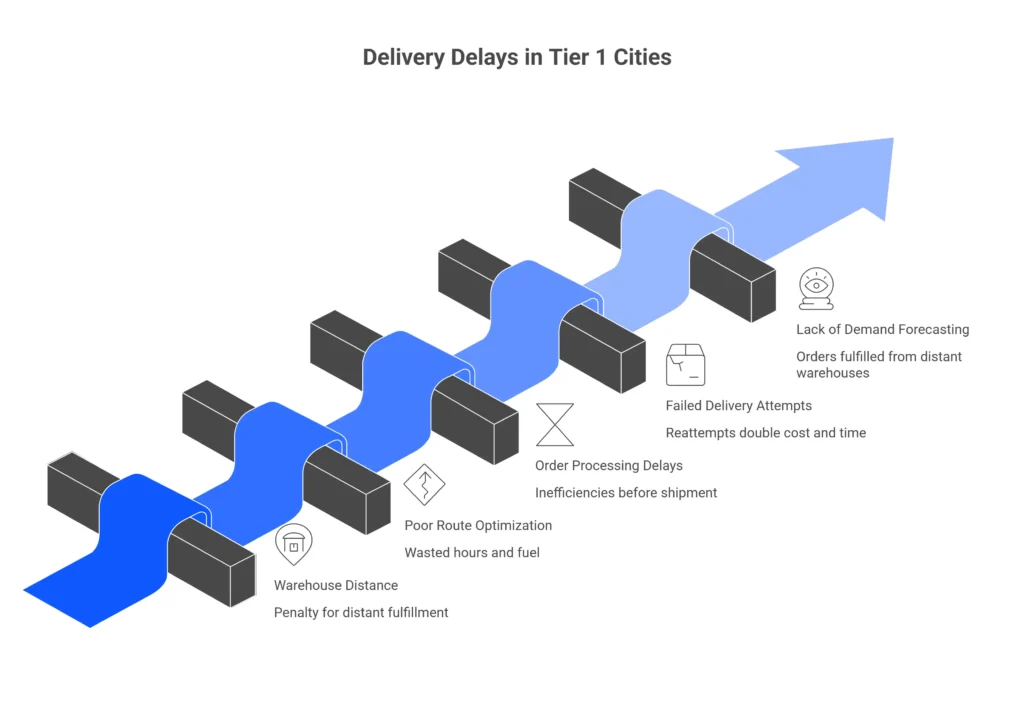
- Failed first delivery attempts: Wrong addresses, unavailable customers, and poor communication lead to reattempts that double your cost and time. Understanding how to reduce RTO in ecommerce is essential for tackling this problem.
- Lack of demand forecasting: Not having the right inventory in the right location means orders get fulfilled from distant warehouses.
Each of these problems has a solution that doesn’t require a bigger budget. It requires a better strategy.
Strategy 1: Move Inventory Closer with Micro-Fulfillment Centers
The single most impactful thing you can do to reduce delivery time is shorten the distance between your inventory and your customers. That’s where micro-fulfillment centers come in.
Instead of relying on one large warehouse on the outskirts of a city, set up smaller inventory hubs within the city itself. These don’t need to be massive facilities. Even a 2,000-3,000 sq ft space in a commercial area can serve as a micro-fulfillment center for your fastest-moving SKUs. To understand the differences between storage models, our comparison of warehouses vs fulfillment centers for ecommerce breaks it down clearly.
How This Saves Cost While Speeding Up Delivery
- Shorter delivery distances mean lower fuel costs and fewer vehicle hours.
- Delivery partners can complete more drops per shift, improving delivery density optimization.
- You reduce the need for expensive express shipping since standard delivery from a nearby hub is already fast.
The key is inventory pre-positioning. Use your sales data and demand forecasting to identify which products sell most in which city zones, then stock those items at the nearest micro-fulfillment center.
Strategy 2: Leverage Dark Stores for Urban Fulfillment
Dark stores have become a cornerstone of the quick commerce delivery strategy in India. A dark store is essentially a mini-warehouse that’s not open to walk-in customers. It exists solely to fulfill online orders. For a detailed breakdown of how these models compare, check out our guide on dark stores vs micro-fulfillment centers for D2C brands.
What makes dark stores effective for reducing delivery time in tier 1 cities:
- They’re located in high-demand neighborhoods, often within 3-5 km of the delivery zone.
- They’re optimized for picking speed, not browsing experience, so orders get packed faster.
- They work perfectly with the hub and spoke model where a central warehouse replenishes multiple dark stores across the city.
You don’t need to be Zepto or Blinkit to use this model. Even D2C brands and mid-size ecommerce companies are partnering with 3PL providers who operate dark store networks. This gives you the speed advantage without the capital investment of setting up your own locations. Our deep dive into hyperlocal fulfillment as a secret weapon for D2C brands explains how this approach is reshaping urban logistics.
Strategy 3: Optimize Delivery Routes with Technology
Route optimization is one of those areas where technology pays for itself almost immediately. Route optimization software analyzes real-time traffic data, delivery locations, time windows, and vehicle capacity to create the most efficient delivery paths.
The Impact on Time and Cost
| Metric | Before Route Optimization | After Route Optimization |
|---|---|---|
| Average deliveries per rider per day | 18-22 | 28-35 |
| Average delivery time per order | 45-60 minutes | 25-35 minutes |
| Fuel cost per delivery | ₹35-50 | ₹20-30 |
| Failed delivery rate | 12-15% | 6-8% |
| Daily route distance per rider | 80-100 km | 55-70 km |
These aren’t hypothetical numbers. Logistics companies across Indian metros are seeing these improvements after implementing automated dispatch and route planning tools. When your riders travel less distance and make more deliveries, you’re simultaneously reducing delivery time and cutting costs. Learn how a dedicated rider app can boost delivery service performance in practice.
Strategy 4: Reduce Order Processing Time Inside the Warehouse
Speed doesn’t start on the road. It starts inside the warehouse. If your order processing takes 4-6 hours before a package is even ready for dispatch, no amount of route optimization will make up for that lost time.
Here’s how to tighten your warehouse operations:
- Automated order allocation: The moment an order comes in, your warehouse management system should automatically assign it to the nearest fulfillment location and trigger the pick list.
- Zone-based picking: Organize your warehouse so pickers work in designated zones rather than walking the entire facility for each order.
- Batch processing: Group similar orders together for picking and packing to reduce redundant trips.
- Barcode scanning and RFID: Eliminate manual data entry errors and speed up verification at every stage from picking to dispatch.
- Pre-printed shipping labels: Generate labels automatically during order processing so they’re ready the moment packing is complete.
Shaving even 2-3 hours off your order-to-dispatch time can mean the difference between next-day delivery and same-day delivery in a metro city. And none of these improvements require significant additional spending. They’re process and technology optimizations that pay for themselves through efficiency gains.
Strategy 5: Use Smart Carrier Allocation
Not every delivery needs the same carrier or the same service level. Smart carrier allocation means matching each order with the most cost-effective delivery option that still meets the customer’s expected delivery time.
For example:
- Orders within 5 km of a dark store can be assigned to hyperlocal delivery partners on two-wheelers, fast and cheap.
- Heavier orders going across the city might be batched for a van route.
- Orders with flexible delivery windows can be grouped into next-day batches to maximize delivery density.
Your delivery fleet management strategy should factor in order weight, distance, urgency, and delivery slot preferences. When you stop treating every order the same and start optimizing allocation, costs drop while speed improves.
Strategy 6: Reduce Failed Deliveries
Here’s a cost that most logistics teams underestimate: failed first delivery attempts. Every failed delivery means a reattempt, which doubles your last mile delivery cost for that order and delays the customer experience. Our detailed guide on last mile delivery challenges in ecommerce India covers the full scope of this problem.
Common causes and fixes:
- Incomplete addresses: Use pin code serviceability validation and address auto-complete at checkout to capture accurate delivery information. Brands are constantly dependent on logistics partners for wider pin code serviceability and reductions in RTOs .
- Customer unavailability: Send real-time order tracking notifications via WhatsApp or SMS so customers know exactly when to expect their package.
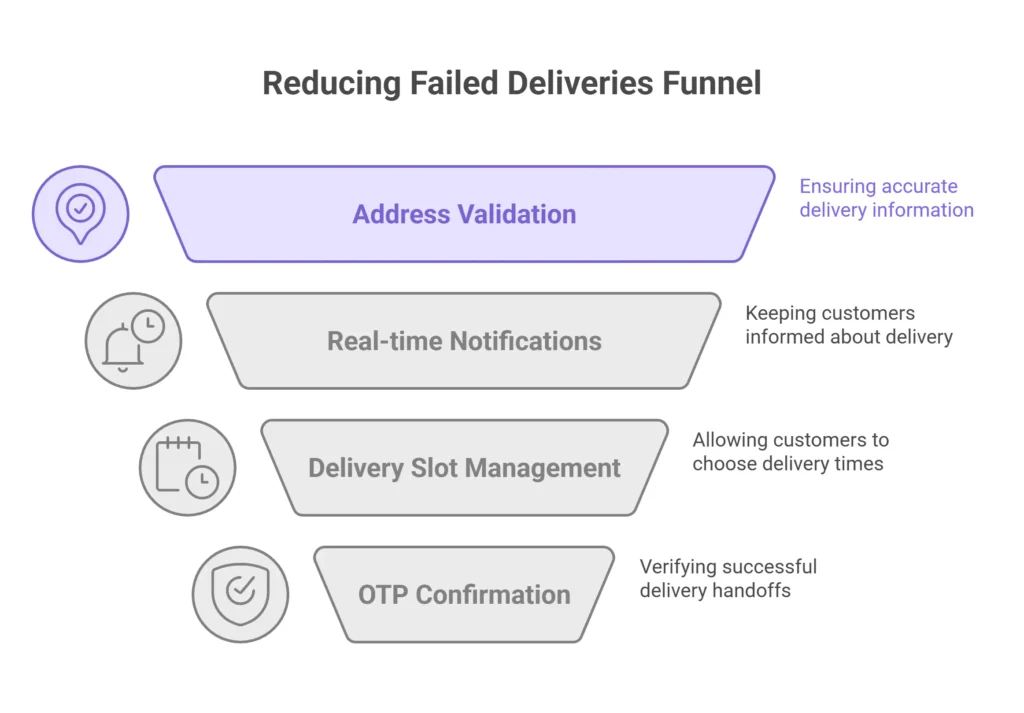
- Delivery slot management: Let customers choose their preferred delivery window. This simple feature dramatically reduces “not at home” failures.
- OTP-based delivery confirmation: Reduces disputes and ensures successful handoffs.
Reducing your failed delivery rate from 15% to 5% doesn’t just save money on reattempts. It frees up delivery capacity that you can use for new orders, effectively increasing your throughput without adding riders or vehicles.
Strategy 7: Implement Demand-Driven Inventory Positioning
This is where data becomes your biggest competitive advantage. Instead of distributing inventory evenly across all locations, use demand forecasting to predict what will sell where and when.
For tier 1 cities, this means:
- Analyzing order history by pin code to identify demand clusters.
- Pre-positioning fast-moving inventory at the closest fulfillment hub before orders come in.
- Adjusting stock levels dynamically based on seasonal trends, promotions, and local events.
When the right product is already sitting in a warehouse 3 km from the customer, you’ve essentially eliminated the biggest variable in delivery time. And since you’re moving inventory proactively in bulk rather than reactively in individual shipments, your transportation costs actually decrease.
Strategy 8: Partner with 3PL Providers Who Have Urban Networks
Building your own delivery infrastructure in every tier 1 city is expensive and time-consuming. A smarter approach for many businesses is partnering with 3PL providers who already have established urban fulfillment networks. For brands exploring same-day and next-day delivery services for SMBs in India, the right 3PL partnership can be transformative.
The right 3PL partner gives you:
- Access to micro-fulfillment centers and dark stores across multiple cities without capital investment.
- Shared delivery fleet capacity that keeps costs low through economies of scale.
- Technology platforms including warehouse management systems, order management, and real-time tracking already integrated and operational.
- Expertise in delivery density optimization and carrier management that would take years to build in-house.
The key is choosing a partner whose network aligns with your customer geography. Ask for pin code-level coverage maps and delivery TAT benchmarks before signing any contract.
Strategy 9: Embrace Delivery Slot Consolidation
This is a tactic that’s gaining traction among smart logistics operators. Instead of offering unlimited delivery windows, consolidate orders into defined delivery slots for specific zones.
For example, all orders for South Mumbai placed before 11 AM get delivered between 4-7 PM the same day. All orders for Whitefield in Bangalore placed before 2 PM get delivered the next morning between 8-11 AM.
Why this works:
- Riders make concentrated deliveries in a tight geographic area, maximizing drops per trip.
- Fuel and time costs per delivery drop significantly.
- Customers get predictable delivery windows, which actually improves satisfaction.
- Failed deliveries decrease because customers know exactly when to expect their package.
It feels counterintuitive to offer fewer delivery options. But in practice, structured slots often deliver faster and cheaper than open-ended “we’ll deliver sometime today” promises. Managing peak hour deliveries effectively is a skill that separates efficient logistics operations from chaotic ones.
The Role of Technology in Tying It All Together
None of these strategies work in isolation. The magic happens when they’re connected through the right technology stack:
- A cloud-based warehouse management system manages inventory across multiple fulfillment locations with real-time visibility.
- Route optimization software plans the most efficient delivery paths daily.
- Automated dispatch assigns orders to the right carrier and delivery slot instantly.
- Real-time order tracking keeps customers informed and reduces failed deliveries.
- Analytics dashboards track delivery SLA compliance, cost per delivery, and rider performance so you can continuously optimize.
The investment in technology is typically modest compared to the savings it generates. Most logistics teams see positive ROI within the first quarter of implementation.
Conclusion
Reducing delivery time in tier 1 cities without increasing cost isn’t about spending more. It’s about spending smarter. Move inventory closer to customers through micro-fulfillment centers and dark stores. Optimize routes so riders cover less ground and make more deliveries. Tighten warehouse operations to cut order processing time. Use data to position the right inventory in the right place before orders even come in.
The companies that master this balance between speed and cost will own the customer experience in India’s metros. Those that don’t will keep choosing between slow delivery and shrinking margins.
Start with one or two strategies from this guide, measure the impact, and build from there. The path to faster, more affordable delivery is incremental, not overnight. But every improvement compounds, and before you know it, you’ll be delivering faster than your competitors at a lower cost.
Frequently Asked Questions
Focus on moving inventory closer to customers through micro-fulfillment centers and dark stores, optimize delivery routes with software, reduce order processing time inside the warehouse, and minimize failed deliveries through better address validation and real-time tracking notifications.
Dark stores are mini-warehouses located in high-demand neighborhoods that exist solely to fulfill online orders. They enable faster picking and shorter delivery distances, making them ideal for same-day and hyperlocal delivery in tier 1 cities without the overhead of traditional retail locations.
Route optimization software analyzes traffic patterns, delivery locations, and vehicle capacity to create the most efficient delivery paths. This allows riders to complete more deliveries per shift while covering less distance, reducing both fuel costs and average delivery time per order.
Inventory pre-positioning means using demand forecasting data to place fast-moving products at fulfillment locations closest to where customers are likely to order them. This eliminates long-distance shipping for individual orders, cutting delivery time and transportation costs simultaneously.
3PL providers offer established urban fulfillment networks including micro-fulfillment centers, dark stores, shared delivery fleets, and integrated technology platforms. Partnering with a 3PL gives businesses access to faster delivery infrastructure without the capital investment of building it from scratch.