HomeBlogUncategorizedHow AI Helps Businesses Decide What Inventory to Stock and Where?
How AI Helps Businesses Decide What Inventory to Stock and Where?
Inventory has always been one of the most important parts of running a business. But as e-commerce, D2C, and quick commerce continue to grow, managing inventory has become much more complicated.
A business may have products sitting across warehouses, dark stores, and fulfilment centers in different cities. Customers in each location may have completely different buying habits. One product might sell quickly in one city but move slowly in another. Demand can also change due to seasons, promotions, local trends, or customer preferences.
How does a business know what inventory to stock and where to keep it?
This is where AI Inventory Optimization can make a real difference.
Instead of depending only on past sales or manual calculations, businesses can use AI to understand demand patterns, forecast what customers are likely to buy, and make smarter decisions about where inventory should be positioned.
For businesses operating across multiple locations, this can be especially valuable.
Why Are Inventory Decisions Becoming Harder?
In the past, inventory planning was often based on experience.
A warehouse manager knew which products usually sold well. The sales team knew which products customers were asking for. The purchasing team looked at previous orders and decided what needed to be replenished.
That approach can still work for a small business. But when a brand starts selling across multiple cities and channels, things become harder to manage.
A business needs to know not just how much inventory it has, but where that inventory is, how quickly it is moving, and whether it is in the right place. Keeping too much inventory creates unnecessary storage costs and ties up working capital. Keeping too little can lead to stockouts and missed sales.
The challenge is therefore not simply to keep more stock. It is to keep the right products, in the right quantities, at the right locations, at the right time.
What is AI Inventory Optimization?
AI Inventory Optimization is the use of artificial intelligence and data to make better inventory planning and stocking decisions.
AI can look at information such as sales history, current stock, product demand, location-wise orders, buying patterns, seasonal changes, and replenishment activity. It can then identify patterns and provide businesses with a clearer picture of what is happening across their inventory network. For example, a company may notice that one product is selling consistently well in a particular region while another product is moving much more slowly there. Instead of treating every warehouse in the same way, the business can adjust its inventory based on actual demand.
This is one of the biggest changes AI brings to inventory management.
Inventory no longer has to be distributed simply because it is convenient. It can be distributed because the data suggests that is where it is needed.
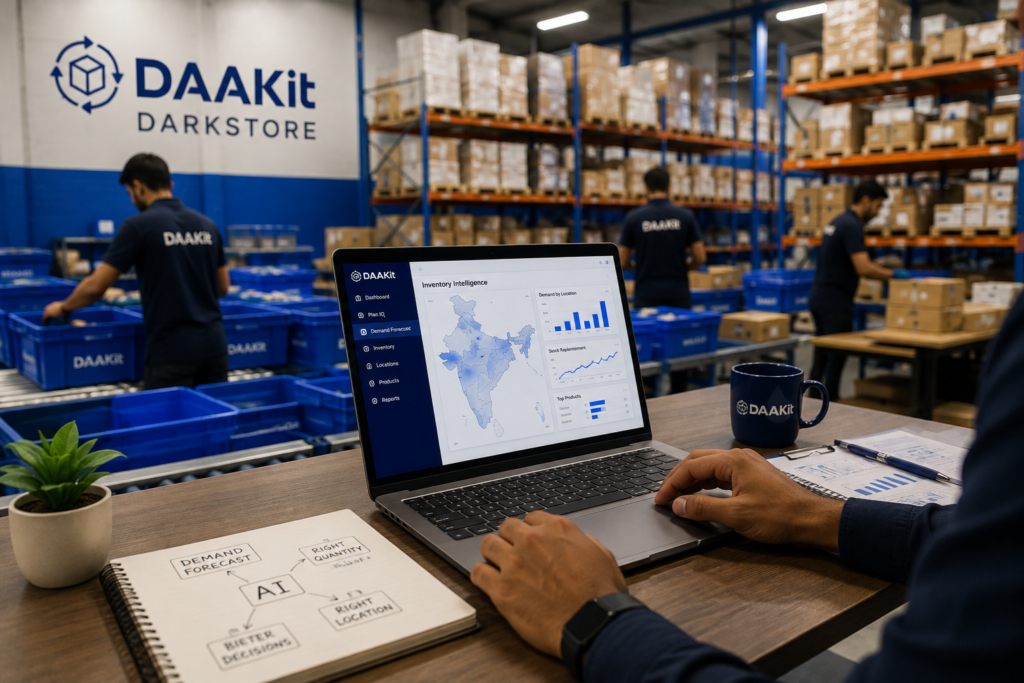
AI Helps Businesses Understand Demand!
One of the biggest challenges in inventory planning is predicting demand.
Businesses naturally want to know what customers will buy next. But demand is not always predictable. Customer behavior can change quickly. A product may suddenly become popular because of social media. A seasonal product may see a sharp increase in demand. A promotion can change the normal sales pattern. AI can analyze large amounts of historical and current data to identify these patterns. It doesn’t mean AI can predict the future perfectly. No system can. What it can do is help businesses make a more informed estimate of future demand.
This allows inventory teams to prepare instead of constantly reacting to what has already happened.
Knowing What to Stock Is Only Half the Answer :
Suppose a business knows that a particular product is going to be in high demand.
The next question is:
Where should that product be stocked?
This is particularly important for businesses with multiple fulfilment locations. Imagine a brand has inventory in Delhi, Mumbai, Bengaluru, and other cities. Demand for the same product may not be equal across these locations.
If inventory is divided equally, some warehouses could end up with excess stock while another location runs out. AI can help businesses understand these differences by analyzing demand at a more local level. This makes inventory allocation more dynamic.
Instead of asking, “How much stock should we keep?”
Businesses can start asking: “How much stock should we keep, and where?”
That small change in thinking can have a major impact on fulfilment.
Why Multi-Location Intelligence Matters
As businesses grow, they often add more warehouses to get closer to customers. This makes faster delivery possible, but it also creates a new challenge: inventory becomes distributed.
A business may have enough stock overall but still face a stockout at a particular location. For example, one fulfilment centre may have excess inventory while another is struggling to meet local demand. Without proper visibility, teams may simply place another purchase order. That can result in more inventory entering the network even though the business already has enough stock elsewhere.
Multi-location intelligence helps businesses see the bigger picture. It brings information from different locations together so teams can understand where products are available, where they are moving quickly, and where replenishment may be required.
This is where AI becomes particularly useful.
How DAAKit Plan IQ Changes Inventory Planning
This is the problem that DAAKit Plan IQ is designed to address.
DAAKit Plan IQ uses AI-driven forecasting to support inventory optimization, demand planning, and replenishment. Rather than looking at inventory as isolated warehouse-level data, it helps businesses think about inventory as part of a connected fulfilment network.
That distinction matters.
For a growing D2C brand, inventory might be spread across multiple fulfilment locations. Each location has its own demand pattern, while the overall business still needs one clear view of inventory.
Plan IQ is designed to bring planning and forecasting into that picture. Instead of relying entirely on manual spreadsheets and assumptions, businesses can use AI-driven insights to understand demand and make more informed inventory decisions.
Understanding What Is Selling
Plan IQ can help businesses identify demand patterns across their inventory network.
- Which products are moving quickly?
- Which products are slowing down?
- Which products are becoming more important?
- Which products need closer attention?
These insights can help businesses prioritize the products that matter most instead of treating every SKU in exactly the same way.
Understanding Where Demand Is Coming From
Knowing that a product is selling well is useful. Knowing where it is selling well is even more useful.
Plan IQ’s role within DAAKit’s planning and forecasting capabilities is particularly relevant for businesses with distributed inventory.
Demand can be different from one city or fulfilment location to another. Understanding those differences can help businesses make better decisions about where products should be positioned.
This is important for D2C and quick-commerce businesses because the location of inventory directly affects how quickly an order can be fulfilled.
Plan IQ and the Future of Multi-Location Fulfilment
DAAKit operates around a model that combines fulfilment, smart warehousing, inventory management and faster delivery. Its platform connects planning and forecasting with the wider fulfilment operation. This creates an important connection between where inventory is placed and how quickly customers can receive it.
A product sitting in the wrong warehouse may technically be available, but it may still be too far away to support a fast delivery promise. This is especially relevant in quick commerce.
Customers don’t think about warehouses. They simply expect the product they want to be available and delivered quickly.
For the business, however, that experience starts much earlier. It starts with deciding where the product should be stored. That is why demand forecasting and inventory placement need to work together.
Plan IQ can play an important role in this process by helping businesses use demand intelligence to support inventory planning across their fulfilment network.
The Future Is Not Just More Inventory. It Is Smarter Inventory.
As e-commerce and quick commerce continue to evolve, businesses will need to become more precise about inventory. Customers expect products to be available. They also expect them to arrive quickly.
That puts pressure on businesses to make better decisions before an order is even placed.
AI can help answer those decisions.
What should we stock?
Where should we stock it?
When should we replenish it?
And perhaps most importantly:
How can we make sure inventory is closer to the customers who actually want it?
This is where DAAKit Plan IQ fits into the modern fulfilment ecosystem. By combining AI-driven demand forecasting, inventory planning and replenishment intelligence with DAAKit’s multi-location fulfilment infrastructure, businesses can move towards a more connected and proactive approach to inventory management.
The future of inventory isn’t about simply keeping more products in more warehouses. It is about understanding demand better and putting the right inventory in the right place.
That is the real promise of AI Inventory Optimization—and that is where intelligent planning can give modern businesses an edge.
Conclusion
Inventory planning in today’s multi-location world is complex, but AI inventory optimization is turning complexity into clarity. By tapping into powerful multi-location intelligence, companies can tailor stock levels precisely, reducing waste and maximizing sales. Tools like DAAKit Plan IQ stand at the forefront of this transformation, making smart inventory management accessible, actionable, and collaborative.