HomeBlogUncategorizedHow Quick Commerce Is Changing Indian Ecommerce in 2026
How Quick Commerce Is Changing Indian Ecommerce in 2026
Introduction
A few years ago, getting an online order within two or three days was considered fast. Now, many customers expect groceries, personal care products, electronics, and daily essentials to arrive in less than an hour. This significant change has led to the rise of quick commerce, one of the fastest-growing parts of India’s digital economy.
What started as a convenience service has become a competitive edge. Consumers increasingly favor brands that can deliver quickly. In response, businesses are investing in technology, dark stores, and hyperlocal fulfillment networks to meet these demands.
As India progresses through 2026, quick commerce is not only about speed; it’s also about building smarter and more efficient supply chains that enhance customer experience and drive business growth.
What Is Quick Commerce?
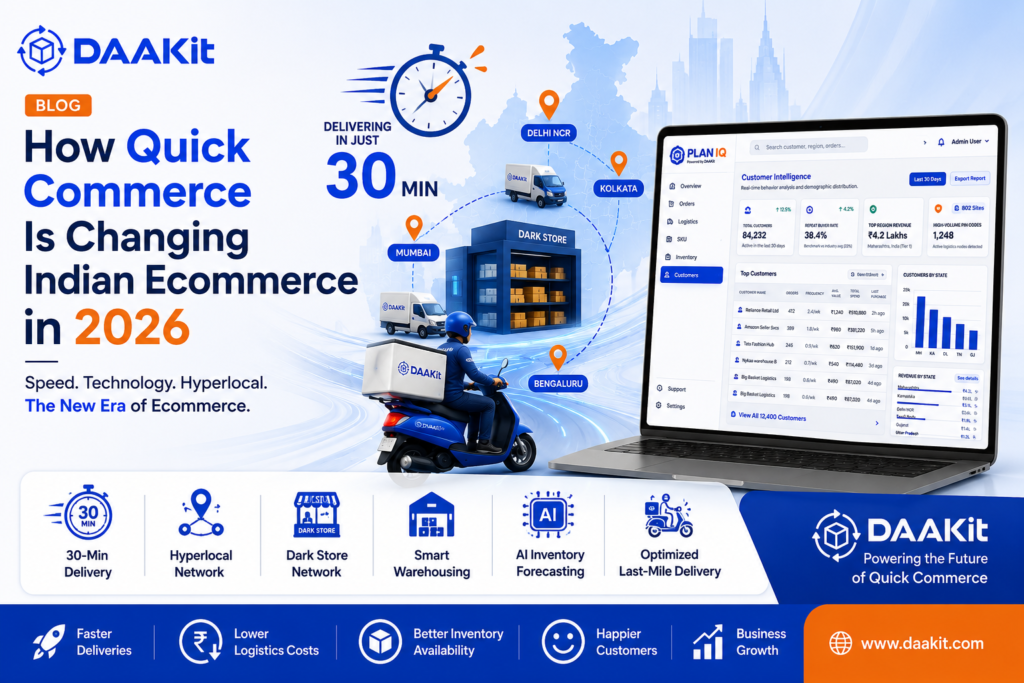
Quick commerce, often called Q-Commerce, evolves from traditional ecommerce, focusing on delivering products within 10 to 60 minutes. It uses strategically located dark stores, local fulfillment centers, and smart routing systems.
The model combines:
• Hyperlocal delivery networks
• Dark stores
• Real-time inventory management
• AI-powered demand forecasting
• Intelligent rider allocation
• Route optimization
Why Quick Commerce Is Growing Rapidly in India
Rising Customer Expectations: Customers now expect same-day or 30-minute delivery.
Smartphone and Internet Penetration: Millions shop through mobile apps every day.
Growth of D2C Brands: Faster delivery improves customer satisfaction and repeat purchases.
The Technology Behind Quick Commerce
AI-Powered Inventory Forecasting ensures the right products are available.DAAKit Plan IQ helps forecast demand and optimize inventory.
Dark Stores bring products closer to customers.
Hyperlocal Fulfillment enables faster deliveries, lower transportation costs, better inventory availability, and improved customer satisfaction.
Route Optimization uses AI based on traffic, rider availability, distance, and weather.
Industries Benefiting from Quick Commerce
• Grocery and FMCG
• Beauty and Personal Care
• Electronics Accessories
• Medicines and Healthcare
• Fashion Essentials
• Pet Supplies
• Home Essentials
• Consumer Electronics
• Food & Beverage
• D2C Brands
Challenges Businesses Face
Inventory Accuracy, Stockouts, High Delivery Costs, and Warehouse Management remain key operational challenges.
How Businesses Can Prepare for the Future
• Investing in AI-powered inventory planning
• Building hyperlocal fulfillment networks
• Improving warehouse visibility
• Using data-driven demand forecasting
• Optimizing last-mile delivery operations
• Reducing stockouts through predictive analytics
The Future of Quick Commerce in India
Quick commerce will expand into Tier-2 and Tier-3 cities. AI, predictive analytics, warehouse automation, and logistics technology will continue improving delivery speed and efficiency.
How DAAKit Enables Faster Commerce
• Hyperlocal Delivery
• Same-Day Delivery (SDD)
• Next-Day Delivery (NDD)
• Smart Warehousing
• Dark Store Operations
• Last-Mile Logistics
• AI-Powered Inventory Forecasting with Plan IQ
By combining smart technology with optimized logistics, DAAKit helps brands deliver exceptional customer experiences while reducing operational costs.
Conclusion
Quick commerce has fundamentally changed how consumers shop and how businesses fulfill orders. Companies investing in AI-driven forecasting, hyperlocal fulfillment, and efficient logistics will be best positioned to thrive in India’s evolving ecommerce landscape.