It’s 5:47 PM on a Tuesday. Your warehouse is buzzing. Orders are stacking up faster than your team can process them. Delivery drivers are stuck in rush hour traffic. And somewhere across town, a customer is refreshing their tracking page, wondering where their package is.
Welcome to the world of peak-hour delivery. For D2C brands, these high-pressure windows can make or break customer relationships. Get it right, and you build loyalty that lasts years. Get it wrong, and you might never see that customer again.
Here’s the thing: peak-hour deliveries aren’t just about moving packages faster. They require a complete rethinking of how you approach direct to consumer shipping. From inventory management to route optimization, every piece of your logistics puzzle needs to work together seamlessly.
This guide will walk you through everything you need to know about mastering peak-hour deliveries. We’ll cover the challenges, explore proven D2C fulfillment strategies, dive into the technology that makes it all possible, and share practical tips you can implement today.
Whether you’re shipping fashion items, food products, or electronics, you’ll find actionable insights to transform your delivery operations. Let’s get started.
What Exactly Are Peak-Hour Deliveries?
Peak-hour delivery refers to the concentrated periods when delivery demand spikes significantly above normal levels. These windows typically occur during specific times of day, week, or year when customer ordering and delivery expectations converge.
For most D2C brands, peak hours happen in predictable patterns:
- Daily peaks: Early morning (7-9 AM) and evening (5-8 PM) when customers are home
- Weekly peaks: Weekends, especially Saturdays
- Seasonal peaks: Holiday shopping seasons, Black Friday, and industry-specific events
- Promotional peaks: Flash sales, product launches, and marketing campaigns
Understanding these patterns is the first step toward delivery optimization. When you know when demand will surge, you can prepare your entire supply chain management operation accordingly.
The challenge is that peak hours don’t just mean more orders. They mean more pressure on every system. Warehouses need to pick and pack faster. Meanwhile, delivery management systems must route more efficiently. Carriers face the added burden of navigating congested streets. And your customers? They still expect the same fast, reliable service they’d get on a quiet Tuesday morning.
Why Peak-Hour Delivery Performance Matters for D2C Success
D2C brands live and die by customer experience. Unlike traditional retail where a store handles the final touchpoint, your delivery is that final touchpoint. It’s the last impression you make before a customer decides whether to order again.
Customer Expectations Have Never Been Higher
Remember when waiting a week for delivery was normal? Those days are long gone. Today’s consumers expect same day delivery or at minimum, next-day options. A recent survey found that 61% of shoppers want their orders within 3 hours of placing them.
These customer delivery expectations D2C brands face aren’t going away. If anything, they’re intensifying. Major retailers have trained consumers to expect two-hour delivery windows as standard. Your D2C brand is competing against that benchmark.
Failed Deliveries Are Expensive
When a delivery fails during peak hours, the costs multiply quickly:
- Redelivery attempts add shipping costs
- Customer service inquiries increase
- Return rates climb
- Negative reviews damage your reputation
- Customer lifetime value drops
One study found that 84% of customers won’t shop with a brand again after a poor delivery experience. That’s not a statistic any D2C brand can afford to ignore.
Peak Performance Reveals Operational Strength
How you handle peak hours tells you everything about your logistics capabilities. Brands that excel during these windows have built resilient systems. They’ve invested in the right technology, developed smart processes, and created flexibility throughout their operations.
In contrast, brands that struggle during peaks often have hidden weaknesses that only surface under pressure. Fixing these issues during a crisis is far harder than addressing them proactively.
The Biggest Challenges D2C Brands Face with Peak-Hour Deliveries
Before diving into solutions, let’s acknowledge the real obstacles standing between you and peak-hour success.
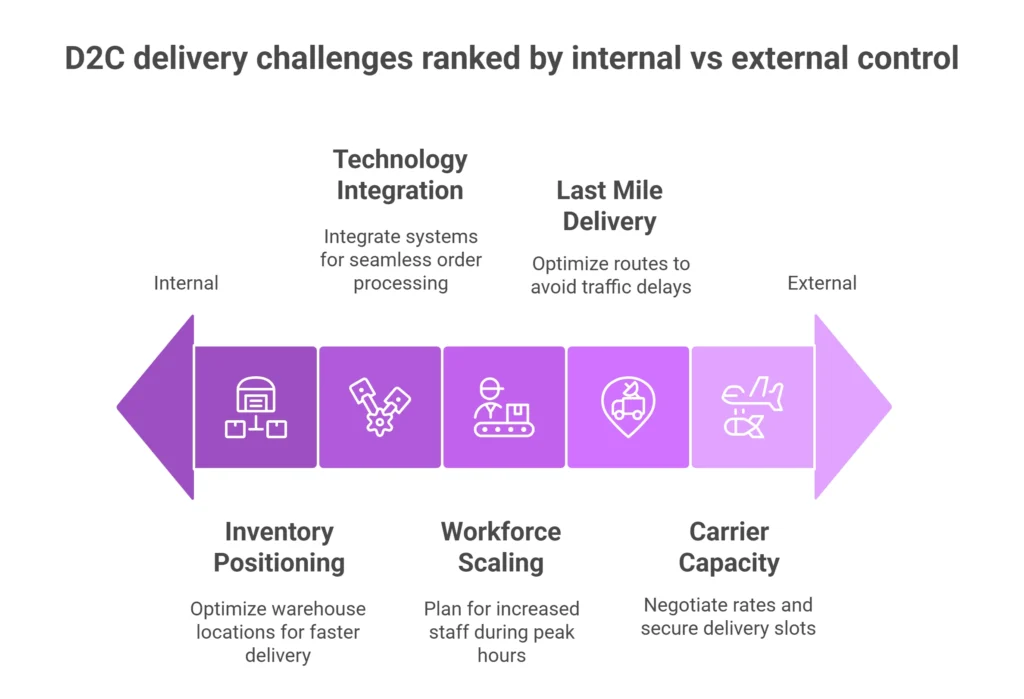
Carrier Capacity Constraints
During peak periods, every brand wants the same thing: more delivery capacity. Carriers become stretched thin. Pickup times get pushed back. Delivery windows become less reliable.
This capacity crunch is especially brutal during holiday seasons when peak season surcharges kick in. Your shipping costs can jump 30-50% while service quality actually declines. Understanding the logistics battle between e-commerce and traditional retail during festivals helps you prepare for these seasonal challenges.
Last Mile Delivery Bottlenecks
The last mile delivery segment accounts for over 50% of total shipping costs, and it’s where most delays occur. Traffic congestion during rush hours, difficulty accessing apartment buildings, and incorrect addresses all compound during peak periods.
For D2C brands, last-mile delivery optimization isn’t optional. It’s where you win or lose the customer experience battle.
Inventory Positioning Problems
Having products in stock is only half the battle. Having them in the right location is what matters. If your inventory sits in a warehouse 500 miles from your customer, you can’t offer competitive delivery time slots no matter how efficient your carriers are.
Understanding the difference between warehouses and fulfillment centers helps you make smarter decisions about inventory management for D2C brands.
Technology Integration Gaps
Many D2C brands have cobbled together delivery systems over time. Their order management platform doesn’t talk to their delivery scheduling software. Their warehouse system doesn’t sync with their carrier integrations. These disconnects create friction that amplifies during peak periods.
Workforce Scaling Difficulties
Peak hours require more hands on deck. Finding, training, and retaining warehouse workers and delivery personnel is increasingly difficult. Surge capacity planning becomes a constant headache.
Proven Strategies to Master Peak-Hour Delivery Optimization
Now for the good news: these challenges are solvable. Here’s how successful D2C brands tackle peak-hour delivery head-on.
Strategy 1: Embrace Predictive Planning
The best time to prepare for peak hours is before they arrive. Use historical data to forecast demand patterns with precision. Look at:
- Order volumes by hour, day, and season
- Product-level demand variations
- Geographic distribution of orders
- Impact of promotions and marketing campaigns
With accurate forecasts, you can staff appropriately, position inventory strategically, and negotiate carrier capacity in advance.
Strategy 2: Diversify Your Carrier Network
Relying on a single carrier is risky during peak periods. Build relationships with multiple carriers and third-party logistics (3PL) for D2C fulfillment. This gives you:
- Backup options when your primary carrier hits capacity limits
- Ability to route orders to the best-suited carrier for each delivery
- Negotiating leverage on rates and service levels
- Geographic coverage flexibility
Smart D2C brands use a delivery management system that automatically selects the optimal carrier based on real-time availability, cost, and delivery speed requirements.
Strategy 3: Implement Dynamic Route Planning
Static delivery routes don’t work during peak hours when conditions change by the minute. Dynamic route planning for D2C brands uses real-time data to continuously optimize driver paths.
Modern delivery route optimization considers:
- Current traffic conditions
- Weather impacts
- Driver location and capacity
- Customer delivery window preferences
- Package priority levels
This approach can reduce delivery times by 20-30% while actually lowering fuel costs.
Strategy 4: Offer Flexible Delivery Options
Not every customer needs their order immediately. Some would happily wait an extra day if it meant lower shipping costs or a specific delivery time slots that works with their schedule.
Give customers control with options like:
- Standard vs. express delivery service
- Specific delivery windows
- Weekend delivery choices
- Alternative pickup locations
- Scheduled delivery dates
When customers choose their own delivery timing, satisfaction increases even if actual delivery speed doesn’t change.
Strategy 5: Distribute Inventory Strategically
The fastest route to same-day delivery D2C success is positioning inventory closer to customers. Consider:
- Multiple fulfillment centers in different regions
- Micro-fulfillment locations in urban areas
- Retail partnerships for ship-from-store capabilities
- 3PL networks with distributed warehouse footprints
Yes, distributing inventory adds complexity. But the delivery efficiency gains often outweigh the operational challenges.
Technology Solutions That Power Peak-Hour Excellence
Technology is the backbone of modern ecommerce delivery solutions. Here’s what your tech stack should include.
Delivery Management Systems
A robust delivery management system serves as your central command center. It connects order sources, warehouse operations, carrier integrations, and customer communications into a unified platform.
Look for systems that offer:
- Real-time order visibility
- Automated carrier selection
- Dynamic routing capabilities
- Customer notification management
- Performance analytics and reporting
The right system transforms chaotic peak periods into manageable operations.
Delivery Scheduling Software
Effective delivery scheduling software lets customers choose when they want their orders delivered while ensuring your operations can actually fulfill those promises.
Advanced scheduling considers:
- Current order volume and capacity
- Geographic clustering of deliveries
- Driver availability and shift timing
- Historical delivery success rates by time slot
This balances customer flexibility with operational reality.
Real-Time Tracking and Communication
Customers want to know where their packages are. Real-time order tracking D2C solutions provide visibility that reduces anxiety and support inquiries.
But tracking is just the start. Proactive communication about delivery exceptions, delays, or changes keeps customers informed before they need to reach out. This transforms potential frustrations into demonstrations of your brand’s reliability.
D2C Logistics Automation Tools
Manual processes can’t scale during peak hours. Automated warehouse management D2C solutions handle:
- Order routing and prioritization
- Pick path optimization
- Packing station assignment
- Carrier label generation
- Quality control checks
Automation doesn’t replace humans. It frees them to focus on exceptions and complex situations rather than routine tasks.
The Rise of Quick Commerce and Its Impact on Peak-Hour Expectations
The emergence of quick commerce has fundamentally shifted what customers consider acceptable delivery times. Understanding quick commerce logistics for D2C brands is essential for staying competitive.
Quick commerce promises delivery in minutes rather than days. While not every D2C brand needs to compete at this level, the expectation spillover affects everyone. Customers who experience 10-minute grocery delivery start wondering why their fashion order takes three days.
For brands evaluating their options, understanding the differences between quick commerce and traditional e-commerce helps inform strategic decisions about where to invest.
Industry-Specific Peak-Hour Considerations
Peak-hour challenges vary significantly across different product categories. Let’s look at three major D2C sectors.
Fashion D2C Delivery Strategies
Fashion brands face unique challenges including high return rates, size variations, and seasonal demand swings. Returns management in D2C logistics becomes critical when 30-40% of orders might come back.
Successful fashion D2C delivery strategies include:
- Offering try-before-you-buy options with extended return windows
- Including prepaid return labels with every shipment
- Using reverse logistics networks for efficient return processing
- Providing accurate sizing tools to reduce unnecessary returns
During peak fashion seasons like back-to-school or holiday gift-giving, these systems get tested to their limits. Learning how to reduce RTO in ecommerce can significantly improve your bottom line.
Food and Beverage D2C Logistics
Perishability adds urgency to every delivery. Food and beverage D2C logistics require strict temperature control, faster delivery windows, and careful handling throughout the chain.
Key considerations include:
- Cold chain packaging solutions
- Same-day or next-day delivery requirements
- Delivery window precision (customers need to be home for perishables)
- Special handling instructions for drivers
- Regulatory compliance for food safety
Peak hours for food delivery often align with meal times, creating extremely concentrated demand windows.
Electronics D2C Shipping Solutions
High-value electronics require security, careful handling, and often signature confirmation. Electronics D2C shipping solutions must balance these requirements against speed demands.
Focus areas include:
- Secure packaging to prevent damage and theft
- Insurance and liability coverage
- Signature requirements without creating delivery failures
- Serial number tracking for warranty purposes
- White-glove delivery options for premium items
Product launch periods create massive peak demand for electronics brands.
Partnering with 3PLs for Peak-Hour Success
Many D2C brands find that third-party logistics (3PL) for D2C operations provide the scalable D2C logistics solutions they need to handle peak demands without massive capital investments.
What to Look for in a 3PL Partner
When evaluating 3PL partnerships, consider:
- Geographic footprint: Do their warehouses align with your customer locations?
- Technology capabilities: Can they integrate with your systems for real-time visibility?
- Carrier relationships: Do they offer diverse delivery options?
- Scalability: Can they flex capacity during your peak periods?
- Industry expertise: Do they understand your specific product requirements?
The right 3PL partner becomes an extension of your brand, handling logistics so you can focus on product and marketing.
Managing Multiple Carriers Through 3PLs
3PL providers often manage relationships with multiple carriers on your behalf. This delivery partner integration simplifies your operations while maintaining flexibility.
However, ensure you maintain visibility into carrier performance. Your delivery tracking for D2C customers shouldn’t suffer just because a third party handles fulfillment.
The Post-Purchase Experience: Beyond Delivery
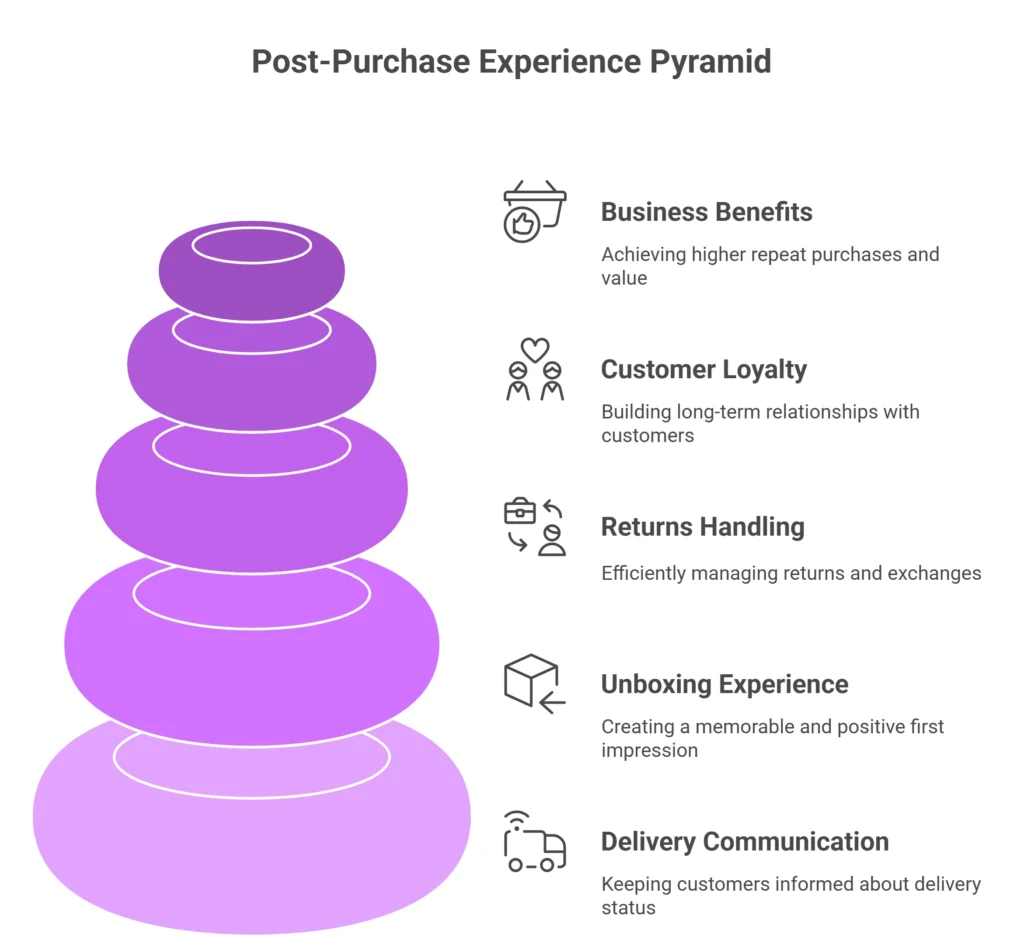
Peak-hour delivery success doesn’t end when the package reaches the doorstep. The post-purchase experience encompasses everything that happens after checkout, including delivery communication, unboxing, and returns handling.
Brands that master the post-purchase journey see:
- Higher repeat purchase rates
- Increased customer lifetime value
- More positive reviews and referrals
- Lower support costs
Even during chaotic peak periods, maintaining focus on the complete customer journey pays dividends.
Measuring and Improving Peak-Hour Performance
What gets measured gets improved. Establish clear delivery performance metrics and track them religiously.
Essential KPIs to Monitor
Track these metrics during peak hours and compare against normal periods:
- On-time delivery rate: Percentage of orders delivered within promised windows
- First attempt delivery success: Orders successfully delivered on the first try
- Order processing speed: Time from order placement to carrier handoff
- Customer satisfaction scores: Post-delivery ratings and feedback
- Cost per delivery: Total delivery cost including failed attempts
- Delivery exception rate: Orders with issues requiring intervention
Continuous Improvement Cycles
Use peak-hour data to drive ongoing optimization:
- Analyze: Review performance data after each peak period
- Identify: Find patterns in failures and bottlenecks
- Prioritize: Focus on issues with the biggest impact
- Implement: Make targeted improvements
- Test: Validate changes during the next peak period
- Repeat: Continue the cycle indefinitely
Each peak period should perform better than the last as you refine your operations.
Communicating with Customers During Peak Periods
Even with perfect operations, some delays are inevitable during peak hours. How you communicate makes all the difference.
Set Realistic Expectations Upfront
During known peak periods, adjust your messaging:
- Update delivery estimates on product pages
- Provide clear cut-off times for same-day or next-day delivery
- Offer alternative options when premium services are unavailable
- Be transparent about potential delays before checkout
Customers who know what to expect rarely complain, even when delivery takes longer.
Proactive Delay Communication
When delays occur, reach out before customers ask. A simple message explaining the situation demonstrates respect for their time. Include:
- Clear explanation of the delay
- Updated delivery estimate
- Contact information for questions
- Apology and acknowledgment of inconvenience
This proactive approach preserves customer satisfaction even when things don’t go perfectly.
Conclusion
Mastering peak-hour delivery isn’t about working harder during busy times. It’s about building systems that scale elegantly when demand surges.
For D2C brands, this means investing in the right technology, developing flexible carrier relationships, positioning inventory strategically, and creating processes that handle pressure without breaking. It means understanding your specific industry challenges and tailoring solutions accordingly.
The brands that get this right build lasting competitive advantages. They turn delivery from a cost center into a customer experience differentiator. They convert first-time buyers into loyal advocates who return again and again.
Ready to transform your peak-hour delivery performance? AI-powered logistics tools can help you predict demand, optimize routes, automate communications, and continuously improve your operations. Explore how modern delivery technology can help your D2C brand deliver exceptional customer experiences, even during your busiest hours.
The future of D2C delivery belongs to brands that prepare today for the peaks of tomorrow.
Frequently Asked Questions
Peak-hour delivery failures stem from carrier capacity constraints, rush hour traffic congestion, and incorrect addresses. Failed first delivery attempts increase when customers aren’t home, while warehouse processing delays can push orders past carrier cutoffs. Better forecasting, real-time tracking, and dynamic route optimization help address these issues.
Segment customers based on preferences since some pay for express shipping while others prioritize savings. Use delivery scheduling software offering multiple checkout options and implement dynamic route planning. Distribute inventory across locations and negotiate volume-based carrier rates to optimize all three factors.
A robust delivery management system forms the foundation by connecting logistics operations in real time. Dynamic routing software, real-time tracking platforms, and automated warehouse systems work together to accelerate processing. Predictive analytics help forecast demand and position resources before peaks arrive.
Analyze customer geography to identify clusters benefiting from closer fulfillment locations. Partner with 3PL providers having distributed warehouse networks rather than building facilities. Start with high-velocity products in secondary locations and use inventory management systems that route orders to optimal fulfillment points automatically.
Proactive communication sets expectations before disappointment occurs and reduces customer anxiety. Real-time delivery updates and exception notifications demonstrate professionalism and build trust. Brands that communicate well maintain high satisfaction even when facing peak-time shipping challenges.