If you’re running an online store and struggling with high return-to-origin rates, learning how to reduce failed deliveries in eCommerce India is no longer optional. It’s survival. Picture this. You’ve spent weeks perfecting your product, running ads, and finally getting that sweet notification: “New order received!” You pack the order, ship it out, and wait. Three days later, the courier marks it as “undelivered” and sends it right back to your warehouse.
Frustrating, right?
If you run an eCommerce business in India, this story probably hits close to home. Failed deliveries in online shopping India remain one of the biggest profit killers for D2C brands and online sellers. Industry estimates suggest that the average RTO (Return to Origin) percentage for Indian eCommerce companies hovers between 25% and 40%, depending on the product category and region. For COD-heavy businesses, the numbers can be even worse.
Every failed delivery costs you double shipping charges, wasted packaging, potential product damage, and a lost customer. And when you factor in the logistics cost differences between COD and prepaid orders, the financial hit becomes even more painful.
So, how do you fix this?
In this guide, we’ll walk through 7 proven strategies to reduce failed deliveries in eCommerce India, improve your eCommerce delivery success rate India, and protect your bottom line. Whether you’re a Shopify seller, a marketplace vendor, or a growing D2C brand, these failed delivery solutions for eCommerce actually work. Let’s dive in.
Why Do Deliveries Fail in Indian eCommerce?
Before jumping into solutions, it helps to understand the root causes of eCommerce delivery failure in India. Knowing why orders fail is the first step toward building a system that prevents them.
The main reasons include:
- Incorrect or incomplete customer addresses (especially in tier 2 and tier 3 cities)
- Customer unavailability during delivery attempts
- Fake or prank orders, particularly with COD
- Cash on delivery refusal at the doorstep
- Poor pin code serviceability in remote areas
- Last mile delivery challenges like inaccessible locations or poor infrastructure
Understanding these pain points makes it much easier to reduce failed deliveries in eCommerce India systematically. Each of these problems has a solution. Let’s break them down one by one.
Strategy 1: Implement AI-Based Address Verification Before Shipping
One of the simplest yet most overlooked failed delivery solutions in eCommerce is verifying the customer’s address before the package ever leaves your warehouse.
Think about it. A surprising number of orders fail simply because the address is wrong. Maybe the customer forgot to add a landmark. Maybe the pin code doesn’t match the city. Or maybe the address field just says “near the big tree.”
Here’s what you can do:
- Integrate an address correction API that validates and auto-corrects addresses at checkout. Tools like Google Maps API, Delhivery’s address validation system, or third-party solutions can catch errors before they become costly.
- Use pin code serviceability checks to confirm that your courier partners actually deliver to that location.
- Flag suspicious addresses that look incomplete or inconsistent for manual review.
This single step can reduce undelivered orders by 10-15% almost immediately. It’s low-hanging fruit that most sellers ignore. The challenge is even bigger when you’re shipping to tier 2 and tier 3 cities across India, where address formats are often inconsistent and landmarks replace proper street names.
Strategy 2: Convert COD Orders to Prepaid Using Smart Incentives
Let’s talk about the elephant in the room. Cash on delivery still dominates Indian eCommerce, accounting for roughly 60-65% of all orders in many categories. And the COD delivery failure rate in India is significantly higher than prepaid orders.
Why? Because COD customers have less commitment. They haven’t paid yet, so refusing the package feels painless. Some customers place impulsive orders and change their mind by the time the courier arrives. This is one of the biggest reasons behind eCommerce delivery failure in India.
The goal isn’t to eliminate COD entirely. That would alienate a huge chunk of your customer base, especially in Bharat eCommerce markets. Instead, focus on COD to prepaid conversion through smart nudges:
- Offer a small discount (₹30-₹50 off) for choosing prepaid at checkout
- Show a “faster delivery for prepaid orders” message
- Use partial COD, where the customer pays a small amount online and the rest on delivery
- Send a WhatsApp or SMS payment link after order placement, encouraging the switch
Even converting 15-20% of your COD orders to prepaid can dramatically improve your delivery success rate and reduce your courier return percentage. If you want a deeper dive into the real cost differences, check out this detailed COD vs prepaid orders logistics cost breakdown for D2C brands.
Strategy 3: Verify Orders with Automated IVR and WhatsApp Confirmation
Here’s a strategy that many successful D2C brands in India swear by. Before shipping a COD order, confirm it.
An automated IVR confirmation call or a WhatsApp order confirmation message takes just seconds but filters out a significant number of fake and impulsive orders. The process is straightforward:
- Customer places a COD order
- An automated system calls or messages the customer within minutes
- The customer confirms the order by pressing a button or replying “Yes”
- Unconfirmed orders are flagged or cancelled before shipping
This is one of the most effective ways to tackle fake order prevention in eCommerce. It’s also surprisingly affordable. Platforms like Shiprocket and several logistics startups offer built-in IVR and WhatsApp confirmation tools.
The result? Fewer wasted shipments, lower RTO rates, and a cleaner order pipeline. This kind of proactive communication is also a key part of building a strong post-purchase experience that keeps customers coming back.
Strategy 4: Optimize Your NDR (Non-Delivery Report) Management Workflow
When a delivery attempt fails, it generates a non-delivery report (NDR). What happens next determines whether that order eventually gets delivered or comes back to your warehouse.
Most sellers make the mistake of leaving NDR management entirely to their courier partners. That’s a problem because courier companies handle thousands of shipments daily. Your undelivered package isn’t their top priority.
To reduce NDR in eCommerce, take an active role:
- Set up real-time NDR alerts so you know the moment a delivery fails
- Contact the customer immediately via call, SMS, or WhatsApp to resolve the issue (wrong address, unavailability, etc.)
- Update the courier with corrected information for a quick reattempt
- Use a delivery management system that automates this entire workflow
The golden window for NDR resolution is 2-4 hours after the failed attempt. The longer you wait, the higher the chance the order becomes an RTO. Speed matters here more than almost anything else. For a comprehensive look at RTO reduction tactics, our detailed guide on how to reduce RTO in eCommerce covers additional strategies worth exploring.
Effective NDR management is honestly one of the fastest ways to reduce failed deliveries in eCommerce India without making any major operational changes.
Strategy 5: Choose the Right Courier Partners and Use a Shipping Aggregator
Not all courier companies perform equally across India. A partner that excels in metro cities might struggle in tier 2 and tier 3 delivery zones. Choosing the wrong courier for the wrong region is a common cause of last mile delivery challenges in India.
Here’s a smarter approach:
- Use a shipping aggregator that gives you access to multiple courier partners (Delhivery, Ecom Express, Blue Dart, India Post, etc.)
- Analyze courier performance by pin code and assign shipments to the partner with the best delivery success rate for that specific area
- Monitor key metrics like delivery attempt rates, RTO percentage, and average delivery time per courier
- Negotiate SLAs (Service Level Agreements) that include penalties for high failure rates
This data-driven courier partner integration approach ensures that each shipment has the best possible chance of reaching the customer. It’s how the top eCommerce logistics optimization strategies work in India.
If you’re looking to reduce delivery time in tier 1 cities or expand into smaller markets, choosing the right logistics partner for each zone is absolutely critical. Some brands are even exploring quick commerce logistics models to stay competitive with faster delivery promises.
Strategy 6: Send Proactive Delivery Updates and Communication
Ever ordered something online and had no idea when it would arrive? You weren’t home when the courier showed up, and the delivery failed. We’ve all been there.
Proactive customer communication is one of the easiest ways to improve delivery success rate in India. When customers know exactly when their package is arriving, they make sure they’re available.
Here’s what effective delivery communication looks like:
- Order confirmation immediately after purchase
- Shipping notification with tracking details when the order is dispatched
- Out for delivery alert on the morning of delivery day
- Estimated delivery time window (e.g., “Your package arrives between 2-5 PM today”)
- Delivery reattempt scheduling if the first attempt fails, letting the customer choose a convenient time
The best channels for this in India are WhatsApp and SMS. Email open rates are low, but WhatsApp messages see 90%+ open rates. Several delivery management software platforms now offer automated WhatsApp delivery updates as a standard feature.
Managing peak hour deliveries becomes much smoother when customers are informed and expecting their packages. When customers feel informed and in control, they cooperate. It’s that simple.
A strong delivery communication flow is also a cornerstone of an excellent post-purchase experience. Brands that nail this see higher repeat purchase rates and better customer lifetime value.
Strategy 7: Use Data Analytics and Machine Learning to Predict and Prevent Failures
This is where things get interesting. The most forward-thinking eCommerce brands in India are now using machine learning fraud detection and predictive analytics to identify high-risk orders before they ship.
Here’s how it works:
- Analyze historical data to identify patterns in failed deliveries (specific pin codes, customer profiles, order values, time of day, etc.)
- Assign a risk score to every incoming order based on these patterns
- Flag high-risk orders for additional verification (IVR confirmation, address check, or prepaid conversion nudge)
- Continuously train the model as new data comes in
For example, if your data shows that COD orders above ₹2,000 from a specific region have a 50% RTO rate, you can automatically trigger extra verification for those orders. Or you might discover that orders placed between midnight and 4 AM have a higher cancellation rate and need confirmation.
This isn’t just for big companies anymore. Several eCommerce logistics startups in India now offer affordable AI-powered tools that even small D2C brands can use. The cost per delivery drops significantly when you stop shipping orders that were never going to be delivered.
Understanding the difference between warehouse and fulfillment center operations also plays a role here. Brands using dedicated fulfillment centers with integrated tech stacks can implement these predictive systems much more efficiently.
Putting It All Together
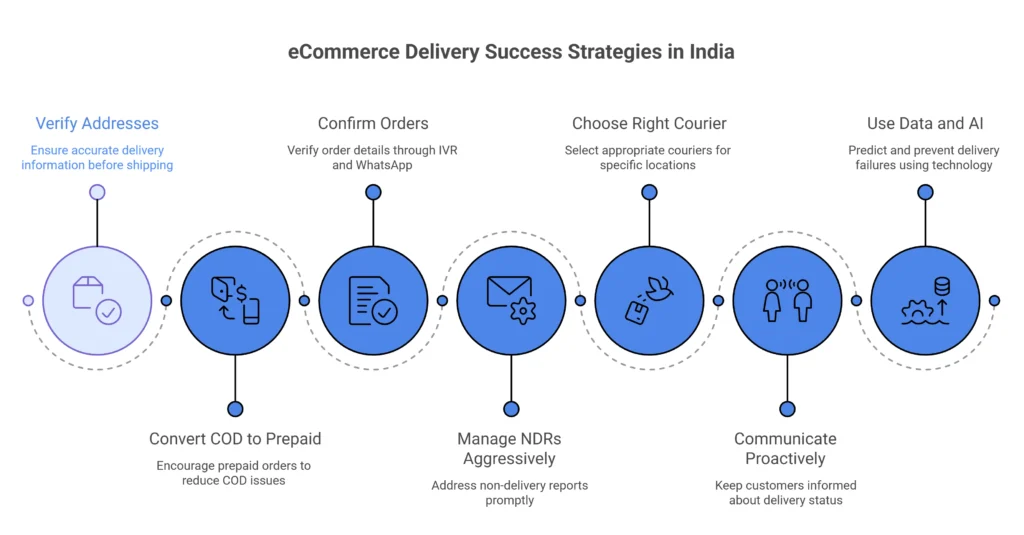
Reducing failed deliveries in eCommerce India isn’t about one magic fix. It’s about building a system where multiple strategies work together:
- Verify addresses before shipping
- Convert COD to prepaid wherever possible
- Confirm orders through IVR and WhatsApp
- Manage NDRs aggressively within hours, not days
- Choose the right courier for the right location
- Communicate proactively with customers
- Use data and AI to predict and prevent failures
When you layer these strategies on top of each other, the compound effect is powerful. Brands that implement even 3-4 of these tactics consistently report a 30-50% reduction in RTO rates and a meaningful improvement in their order fulfillment rate and customer lifetime value.
The eCommerce shipping issues India faces are real, but they’re solvable. Every failed delivery solution for eCommerce we’ve discussed above is actionable today. The brands that figure this out first will have a significant competitive advantage, especially as online shopping continues to grow in tier 2, tier 3, and beyond. And if you’re also dealing with reverse logistics challenges, getting your forward delivery right is the first step to reducing costly returns.
Start with the strategies that are easiest to implement for your business, measure the results, and iterate. Your warehouse (and your profit margins) will thank you.
Frequently Asked Questions
The most common reason is incorrect or incomplete customer addresses, followed closely by customer unavailability during delivery attempts and COD order refusals. In tier 2 and tier 3 cities, poor pin code serviceability and last mile delivery infrastructure challenges also contribute significantly to eCommerce delivery failure in India.
To reduce return to origin in eCommerce India, focus on a combination of address verification at checkout, COD to prepaid conversion incentives, automated order confirmation via IVR or WhatsApp, aggressive NDR management within 2-4 hours of a failed attempt, and smart courier partner allocation using a shipping aggregator. Data-driven approaches using machine learning fraud detection also help identify and flag high-risk orders before dispatch.
NDR stands for Non-Delivery Report, which is generated every time a courier fails to deliver a package. Effective NDR management involves immediately contacting the customer after a failed delivery attempt, resolving the issue (wrong address, unavailability, etc.), and updating the courier for a quick reattempt. A strong NDR workflow using a delivery management system can recover 20-30% of orders that would otherwise become RTOs. Learn more about comprehensive RTO reduction strategies to complement your NDR process.
COD orders have 2-3x higher failure rates than prepaid because customers haven’t financially committed to the purchase. Converting even a small portion to prepaid through discounts or WhatsApp payment links helps significantly. Learn more in our COD vs prepaid logistics cost breakdown.
The shorter the gap between order placement and delivery, the less likely a customer is to cancel or be unavailable. Same-day and next-day delivery services reduce impulse-driven cancellations. Brands using hyperlocal fulfillment strategies are seeing some of the lowest RTO rates in the industry.