Choosing the best logistics partner for your D2C brand in India can feel like hiring a co-founder. Get it right, and your brand grows with happy customers, fast deliveries, and healthy margins. Get it wrong, and you’re stuck dealing with delayed shipments, angry reviews, and bleeding money on returns.
Here’s the thing most D2C founders learn the hard way: your logistics partner isn’t just a vendor. They’re the last touchpoint between your brand and your customer. That courier person handing over the package? In your customer’s mind, they represent you. So this decision deserves more thought than most founders give it.
Whether you’re shipping 50 orders a day or 5,000, whether you’re selling skincare, fashion, electronics, or food, this guide will help you evaluate and choose the right eCommerce logistics partner in India for 2026 and beyond.
We’ll cover everything from pin code coverage and pricing models to technology integration and RTO management. Let’s get into it.
Why Your Logistics Partner Choice Matters More Than Ever in 2026
The Indian D2C landscape has changed dramatically. Customers now expect same-day and next-day delivery as standard, not a luxury. Quick commerce has reset delivery expectations across the board. And with D2C brands expanding aggressively into tier 2 and tier 3 cities, your logistics infrastructure needs to keep pace.
A few realities that make this decision critical in 2026:
- Customer expectations are sky-high. Two-day delivery is now the baseline. Anything slower feels outdated.
- RTO rates eat profits. If your logistics partner can’t deliver successfully, you’re paying double shipping on every failed order.
- COD still dominates. In many categories, 50-60% of orders are cash on delivery, which means your logistics partner needs strong COD management capabilities.
- Scalability is non-negotiable. Festival seasons can 5x your order volume overnight. Your partner needs to handle that without breaking.
The brands that get logistics right in 2026 will win. The ones that don’t will keep losing money to failed deliveries, slow shipping, and poor customer experiences.
Shipping Aggregator vs 3PL vs Direct Courier: Which Model Fits Your D2C Brand?
Before evaluating specific companies, you need to understand the three main logistics models available to D2C brands in India. Each has its place depending on your business stage and needs.
Shipping Aggregators
Platforms like Shiprocket, Pickrr, and ClickPost give you access to multiple courier partners through a single dashboard. You get to compare rates, choose couriers per shipment, and manage tracking in one place.
Best for: Early-stage D2C brands shipping 10-500 orders/day who want flexibility without commitment.
Limitations: You don’t get dedicated support, warehouse services, or deep integration. As volume grows, the per-shipment cost advantage shrinks.
3PL Fulfillment Partners
Third-party logistics providers like DAAKit handle everything from warehousing and inventory management to pick-pack-ship and last mile delivery. They store your products in their fulfillment centers, process orders, and ship them out.
Best for: Growing D2C brands shipping 200+ orders/day who want to outsource operations and focus on marketing and product.
Advantages: Faster delivery through multi-warehouse networks, lower per-order costs at scale, dedicated account management, and better RTO rates.
Direct Courier Partnerships
Working directly with courier companies like Delhivery, Blue Dart, or Ecom Express. You negotiate rates, manage relationships, and handle warehousing yourself.
Best for: Large D2C brands with in-house logistics teams and 1,000+ daily orders who want maximum control.
Limitations: Requires significant operational bandwidth. You need your own warehouse, packing team, and logistics manager.
The key question is: where is your brand right now, and where will it be in 12 months? Choose a model that fits both.
8 Critical Factors to Evaluate When Choosing a Logistics Partner
Now let’s get practical. Here’s your logistics partner checklist for D2C brands with the factors that actually matter.
1. Pin Code Coverage and Serviceability
India has over 19,000 pin codes. No single courier covers all of them equally well. When evaluating a logistics partner, ask:
- How many pin codes do they service for forward delivery?
- What about reverse logistics coverage?
- How strong is their network in tier 2 and tier 3 cities?
- Do they have last mile delivery capabilities in the regions where your customers are?
A partner with 25,000+ serviceable pin codes sounds impressive, but what matters is their delivery success rate in the specific areas where you get orders. Ask for pin code-level performance data, not just total coverage numbers.
2. Delivery Speed and SLA Commitments
Speed sells. In 2026, customers compare your delivery time against quick commerce apps. While you may not need 10-minute delivery, you absolutely need reliable 2-3 day shipping for metro cities and 4-5 days for the rest.
Evaluate:
- What’s their average delivery TAT (turnaround time) for tier 1 cities?
- Can they offer same-day or next-day delivery in key metros?
- What SLAs do they commit to in writing?
- What happens when they miss SLAs? Are there penalties or credits?
A logistics partner that promises 2-day delivery but consistently delivers in 4-5 days is worse than one that promises 3 days and delivers on time. Consistency matters more than speed claims.
3. RTO Rate and NDR Management
This is where most D2C brands lose money. Your logistics partner’s ability to reduce failed deliveries directly impacts your profitability.
Questions to ask:
- What’s their average RTO rate across similar D2C brands?
- How do they handle NDR (Non-Delivery Reports)? Is it automated or manual?
- Do they offer delivery reattempts? How many?
- Can they share real-time NDR data so your team can intervene quickly?
- Do they support IVR or WhatsApp confirmation for COD orders?
A good 3PL partner should have systems in place to reduce RTO proactively, not just report failures after the fact. Look for partners with RTO rates below 20% for your category.
4. Technology and Integration Capabilities
In 2026, a logistics partner without strong tech is a liability. You need seamless integration with your sales channels, real-time visibility, and automated workflows.
Must-have technology features:
- API integration with Shopify, WooCommerce, Amazon, and other platforms
- Real-time tracking with customer-facing tracking pages
- Automated dispatch and label generation
- Logistics dashboard with analytics on delivery performance, RTO trends, and cost breakdowns
- Warehouse management system (WMS) if they handle fulfillment
- Order management system (OMS) for multi-channel order routing
If a logistics partner asks you to manually upload CSV files for order processing in 2026, run. Tech-enabled logistics isn’t optional anymore. It’s the baseline.
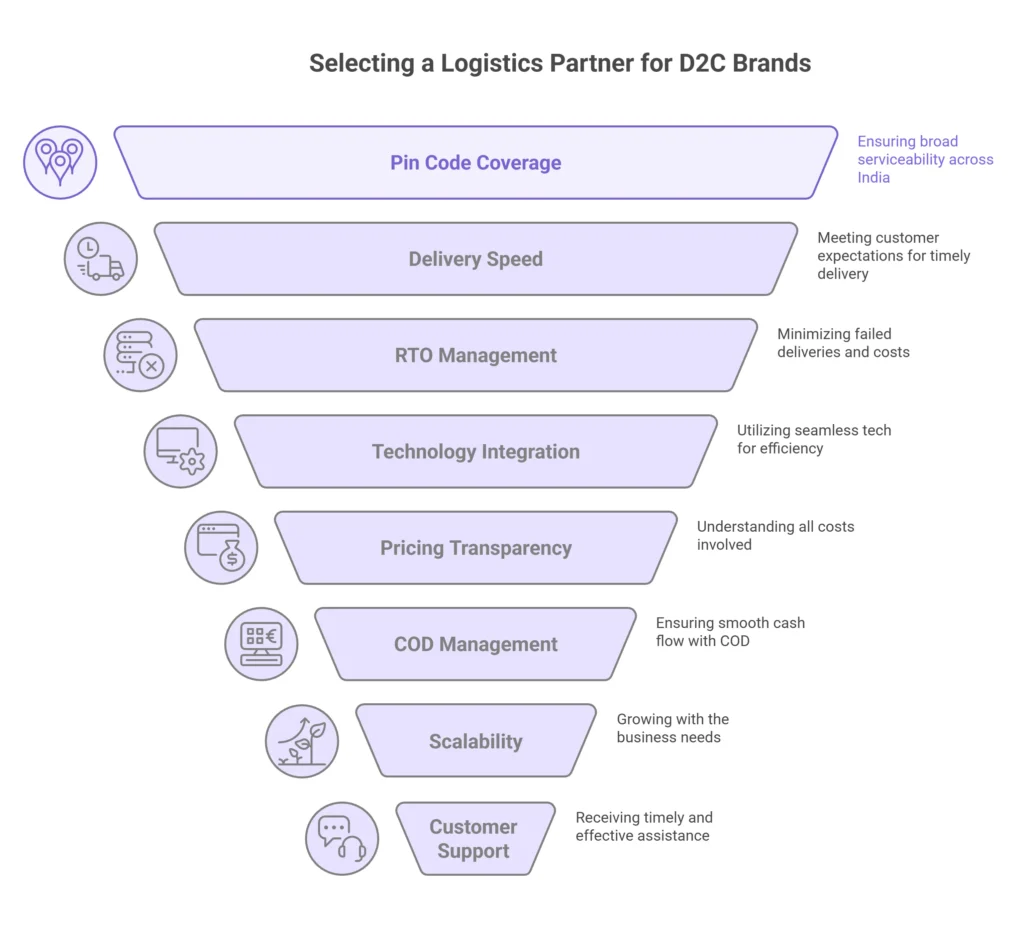
5. Pricing Transparency and Cost Structure
Logistics costs can make or break D2C unit economics. But the cheapest partner isn’t always the best. Hidden fees, poor delivery rates, and high RTO costs can make a “cheap” partner very expensive.
Understand their pricing model:
- Weight-based vs zone-based pricing — which do they use?
- COD charges — what’s the percentage or flat fee?
- Reverse logistics cost — what do you pay when an order comes back?
- Warehousing fees — storage charges, pick-pack fees, packaging costs
- Hidden fees — fuel surcharges, handling charges, address correction fees, COD remittance delays
Ask for a complete rate card and calculate your effective cost per delivered order, not just cost per shipment. Factor in RTO costs to get the true picture. Sometimes a partner that charges ₹10 more per shipment but has 15% lower RTO rates saves you significantly more money overall.
6. COD Management and Remittance Cycle
Since COD remains dominant in Indian eCommerce, your logistics partner’s COD handling directly affects your cash flow.
Key questions:
- What’s their COD remittance cycle? (Daily, weekly, bi-weekly?)
- Do they offer early COD remittance options?
- What’s their COD delivery success rate vs prepaid?
- Do they support COD-to-prepaid conversion tools?
- How do they handle COD reconciliation and discrepancies?
A partner with a 7-day COD remittance cycle vs a 2-day cycle can create serious cash flow problems for a growing D2C brand. This is especially critical during festival season logistics when order volumes spike.
7. Scalability and Multi-Warehouse Capabilities
Your logistics partner needs to grow with you. What works at 100 orders/day might collapse at 1,000.
Evaluate scalability:
- Can they handle 3-5x volume spikes during sales and festivals?
- Do they have multiple warehouse locations across India?
- Can they support hyperlocal fulfillment for faster delivery?
- What’s their onboarding timeline for new warehouses or regions?
- Do they support multi-channel fulfillment (website + marketplace + quick commerce)?
A partner with warehouses in Delhi NCR, Mumbai, Bengaluru, Kolkata, and Chennai can position your inventory closer to customers, enabling faster delivery times in tier 1 cities and reducing shipping costs through zone optimization.
8. Customer Support and Account Management
When things go wrong (and they will), how quickly can you get help? This is often the most underrated factor in logistics partner selection.
Look for:
- Dedicated account manager vs generic support tickets
- Response time SLAs for escalations
- Proactive communication about delays, service disruptions, or issues
- Claims settlement process — how fast do they resolve lost/damaged shipment claims?
- Onboarding support — do they help you set up integrations and optimize workflows?
Talk to other D2C brands using the same partner. Ask about their support experience during peak seasons when things get chaotic. That’s when you’ll see the real quality of a logistics partner.
Red Flags to Watch For When Evaluating Logistics Partners
Not every logistics company that pitches you deserves your business. Here are warning signs to watch for:
- No transparent pricing — if they can’t give you a clear rate card upfront, expect surprises later
- No tech integration — manual processes mean errors, delays, and zero visibility
- Vague SLA commitments — “we try to deliver in 2-3 days” is not an SLA
- High minimum volume requirements — some partners lock you into commitments you can’t meet
- Poor claims settlement — if they take 30-60 days to settle a lost shipment claim, your cash flow suffers
- No pin code-level performance data — they should be able to show you delivery success rates by region
- Lock-in contracts — avoid partners that require 12-month commitments without performance guarantees
Trust your gut. If the sales process feels pushy or the answers feel vague, the operational experience will likely be worse.
When Should You Switch Logistics Partners?
Sometimes the partner you started with isn’t the partner you need now. Here are signs it’s time to evaluate alternatives:
- Your RTO rate has been consistently above 25% for 3+ months
- Delivery TAT is regularly exceeding promised SLAs
- Customer complaints about delivery are increasing
- You’re expanding to new regions they don’t cover well
- Their technology can’t keep up with your multi-channel needs
- COD remittance delays are hurting your cash flow
- You’ve outgrown their capacity and they can’t scale with you
Switching logistics partners is disruptive, so don’t do it impulsively. But don’t stay with a bad partner out of inertia either. The cost of poor logistics compounds every single day.
A Practical Checklist Before You Decide
Before signing with any logistics partner for your D2C brand, run through this quick checklist:
- Verified pin code coverage for your top 20 delivery cities
- Received clear, written rate card with all fees disclosed
- Confirmed API integration with your eCommerce platform
- Checked RTO rates for brands in your category
- Understood COD remittance cycle and terms
- Reviewed SLA commitments with penalty clauses
- Spoken to 2-3 existing clients about their experience
- Tested their tracking page and customer communication flow
- Confirmed scalability for 3-5x volume during peak seasons
- Evaluated their reverse logistics capabilities
Final Thoughts
Choosing the best logistics partner for your D2C brand in India isn’t a one-time decision. It’s an ongoing relationship that needs regular evaluation. The logistics landscape in 2026 is more competitive and capable than ever, which means you have options.
Start by understanding your own needs clearly. How many orders do you ship? Where are your customers? What’s your current RTO rate? What’s your budget per shipment? Once you have clarity on these basics, evaluating partners becomes much more straightforward.
Remember, the cheapest option is rarely the best. The best logistics partner is the one that delivers your products reliably, protects your brand reputation, and scales with you as you grow. They should feel like an extension of your team, not just another vendor.
Take your time with this decision. Your customers, your margins, and your brand’s future depend on it.
Frequently Asked Questions
Focus on pin code coverage, delivery speed SLAs, RTO rates, technology integration, pricing transparency, and scalability. Also evaluate their COD management, NDR handling, and customer support quality. The right partner should align with your current order volume and growth plans.
A shipping aggregator gives you access to multiple courier partners through one platform for shipping only. A 3PL (third-party logistics) partner handles end-to-end fulfillment including warehousing, inventory management, pick-pack-ship, and delivery. 3PLs are better for brands that want to outsource operations completely.
Costs vary based on weight, delivery zone, and partner. Typically, intra-city shipments cost ₹30-50, intra-zone ₹50-80, and national shipments ₹80-150 for packages under 500g. Add COD charges (1.5-2.5%), reverse logistics fees, and warehousing costs for the full picture. Always calculate cost per delivered order including RTO expenses.
Yes. A multi-courier strategy lets you assign shipments to the best-performing courier for each pin code, reducing delivery failures and improving speed. Use a shipping aggregator or 3PL with multiple courier integrations to implement this without managing each relationship separately.
Consider switching when you’re consistently shipping 200+ orders daily, spending too much time on packing and dispatch, experiencing high RTO rates, or expanding to regions that need faster delivery through decentralized inventory. A 3PL becomes cost-effective and operationally superior at this scale.