Tier 2 Tier 3 city delivery India is quickly becoming the most important conversation in the D2C ecommerce space. Picture this. A 24-year-old woman in Jhansi scrolls through Instagram, spots a skincare brand she loves, taps “Buy Now,” and waits. And waits. And waits some more. Her order either takes 10 days to arrive, gets returned because the delivery partner couldn’t find her address, or never shows up at all. This is the reality of Tier 2 Tier 3 city delivery India faces today, and it’s not just a logistics problem. It’s a massive, largely untapped business opportunity that smart D2C brands are racing to solve.
India’s ecommerce story has long been written around metros like Mumbai, Delhi, and Bangalore. But the next chapter? It’s being written in places like Patna, Raipur, Agartala, and Siliguri. The Indian D2C market opportunity in these smaller cities is enormous, and the brands that figure out delivery first will own the market.
Smart logistics platforms like DAAKit are already helping D2C brands bridge this gap. As a smart logistics startup, DAAKit helps smaller brands match the speed of ecommerce giants through seamless e-commerce integrations, API connectivity, and scalable infrastructure that adapts to both traditional ecommerce volumes and high-frequency quick commerce orders .
Let’s break down exactly why this matters, what’s holding brands back, and how smart D2C companies are cracking the code.
Why Tier 2 and Tier 3 Cities Are the Real Growth Engine
If you’re still focused only on metro customers, you’re fighting over a shrinking slice of the pie. The real growth in ecommerce in Tier 2 and Tier 3 cities has been staggering. According to multiple industry reports, these markets have been growing 2 to 3 times faster than metro ecommerce since 2023.
Several factors are driving this shift:
- The Jio effect on ecommerce: Affordable data and smartphones have brought hundreds of millions of new users online. Digital adoption in small-town India has skyrocketed, with first-time internet users increasingly comfortable browsing and buying online.
- Aspirational consumer India: Consumers in smaller cities want the same brands, the same quality, and the same experience as their metro counterparts. They follow the same influencers, watch the same reels, and have growing disposable incomes.
- Ecommerce penetration in Tier 2 and Tier 3 India is still relatively low compared to metros. That means there’s a huge runway for growth. The market isn’t saturated. It’s barely been touched.
- Social commerce in Tier 2 cities is booming. Platforms like Instagram, YouTube, and even WhatsApp commerce in India are becoming primary discovery and purchase channels for consumers who may never visit a brand’s website directly.
The numbers tell the story clearly. Tier 2 city ecommerce growth has consistently outpaced metro growth, and Tier 3 city online shopping trends show increasing basket sizes and repeat purchase rates.
So why aren’t more D2C brands in India rushing to serve these customers?
The answer, almost always, comes down to delivery.
The Delivery Challenge Nobody Wants to Talk About
Let’s be honest. Last mile delivery in Tier 2 cities in India is hard. And in Tier 3 cities? Even harder. The D2C brands delivery challenges in India when it comes to smaller cities are real, complex, and expensive. If you want a deeper understanding of these pain points, DAAKit’s detailed guide on last mile delivery challenges in ecommerce India is worth reading.
Here’s what brands are up against:
Limited Pin Code Serviceability
Pin code serviceability is the most fundamental barrier. Many logistics providers simply don’t deliver to a large percentage of pin codes in Tier 2 and Tier 3 India. If your 3PL partner covers 15,000 pin codes but your customer lives in one of the 5,000 they don’t serve, that sale is dead on arrival.
This is especially painful for direct to consumer brands India delivery models, where the brand owns the entire customer relationship. You can’t blame a marketplace. The customer blames you.
High RTO Rates
Return to origin (RTO) rates in smaller cities tend to be significantly higher than in metros. Incomplete addresses, failed delivery attempts, and customer unavailability all contribute. Some brands report RTO rates of 25 to 35% in Tier 3 markets, compared to 15 to 20% in metros.
Every RTO is a double hit: you pay for forward shipping AND return shipping, with no revenue to show for it. If RTO is eating into your margins, check out this practical guide on how to reduce RTO in ecommerce.
Cash on Delivery Dominance
Cash on delivery in small towns remains the preferred payment method. While prepaid vs COD adoption rates have been shifting slowly toward digital payments, COD still accounts for 60 to 70% of orders in many Tier 2 and Tier 3 markets. This creates cash flow challenges, increases RTO risk (COD orders have higher cancellation rates), and adds operational complexity.
Infrastructure Gaps
Warehousing in Tier 2 cities is limited and often expensive relative to the quality available. Road connectivity, address standardization, and delivery fleet coverage all lag behind metro standards. Last mile delivery challenges in India are amplified when the “last mile” is actually the last 50 kilometers on a poorly maintained road. Understanding the difference between a warehouse and a fulfillment center can help brands make smarter infrastructure decisions.
Higher Per-Order Costs
Affordable logistics for D2C brands is critical to unit economics. But shipping to smaller cities often costs 20 to 40% more per order than metro delivery. For brands selling products in the Rs 500 to Rs 1,500 range, that cost difference can wipe out margins entirely.
These challenges are real. But they’re not insurmountable. And the brands solving them are gaining a serious competitive advantage.
How Smart D2C Brands Are Cracking the Code
The good news? The D2C logistics India ecosystem is evolving rapidly. Platforms like DAAKit are at the forefront of this evolution, offering pick, pack, and ship operations from warehouse locations with seamless ecommerce integrations that make Tier 2 and Tier 3 expansion operationally feasible . Here’s how forward-thinking brands are tackling Tier 2 Tier 3 city delivery in India and winning.
Partnering with Smart Logistics Platforms
No single logistics company covers every pin code efficiently. Smart brands work with technology-driven logistics partners like DAAKit and use intelligent routing to assign each order to the carrier with the best serviceability, speed, and cost for that specific pin code.
DAAKit’s scalable infrastructure adapts to both traditional ecommerce volumes and the high-frequency, low-quantity nature of quick commerce orders , making it an ideal partner for brands navigating the complexity of small town delivery services in India. For brands exploring quick commerce as a channel, this guide on quick commerce logistics for D2C brands breaks down the operational model.
Setting Up Regional Micro-Warehouses and Dark Stores
Instead of shipping everything from a single warehouse in Delhi or Mumbai, brands are setting up smaller fulfillment centers closer to demand clusters. This reduces delivery time, cuts shipping costs, and improves the customer experience.
Some brands are even exploring dark stores in semi-urban India as micro-fulfillment hubs, especially for high-velocity SKUs. The math is simple: shorter shipping distances mean lower costs and faster delivery. If you’re weighing your options, DAAKit’s comparison of dark stores vs micro-fulfillment centers is an excellent resource for D2C decision-makers.
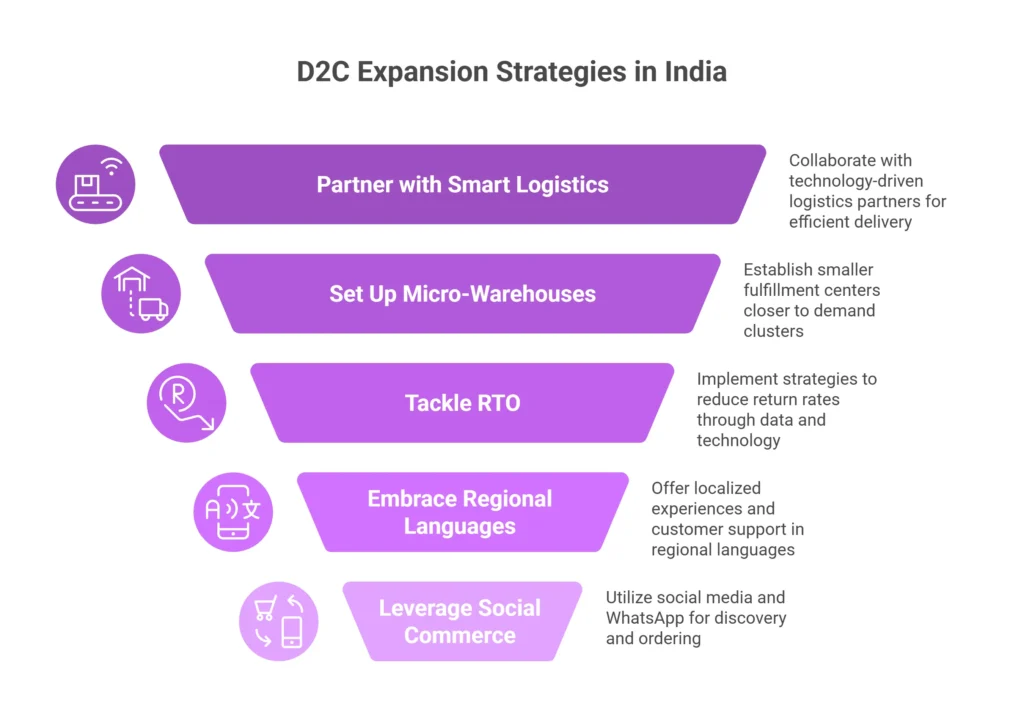
Tackling RTO with Data and Technology
Reducing RTO rates requires a combination of address verification, customer confirmation (automated calls or WhatsApp messages before dispatch), and smart fraud detection. Some brands use AI-based models to flag high-risk orders, particularly COD orders from pin codes with historically high RTO rates.
Others are incentivizing prepaid payments through discounts, which simultaneously reduces RTO risk and improves cash flow. Understanding reverse logistics: how it works, types, and strategies is essential for any brand serious about managing returns efficiently.
Embracing Regional Language and Localized Experiences
Regional language ecommerce isn’t a nice-to-have anymore. It’s essential. Brands that offer their websites, apps, and customer communications in Hindi, Tamil, Bengali, Telugu, and other regional languages see significantly higher conversion rates in Tier 2 and Tier 3 markets.
This extends to customer support too. A customer in Coimbatore who can resolve a delivery issue in Tamil is far more likely to order again than one forced to navigate English-only support.
Leveraging Social and WhatsApp Commerce
D2C shipping to small cities often starts with discovery on social media. Brands that invest in regional influencer partnerships, vernacular content, and WhatsApp commerce in India are seeing strong traction in markets where traditional digital marketing (Google Ads, Facebook Ads) may be less effective.
WhatsApp, in particular, has become a powerful ordering and customer service channel. Many consumers in Tier 2 and Tier 3 cities are more comfortable placing orders via WhatsApp than navigating a website.
Nailing the Post-Purchase Experience
Here’s something many brands overlook: the sale doesn’t end at checkout. In Tier 2 and Tier 3 cities, where brand trust is still being built, the post-purchase experience can make or break customer loyalty. Real-time tracking updates, proactive delay notifications, and hassle-free returns all matter enormously. DAAKit’s insights on post-purchase experience: why it matters and how to master it offer a practical playbook for getting this right.
The Economics: Why It’s Worth the Effort
You might be thinking: “This all sounds expensive and complicated. Why bother?”
Here’s why the Bharat ecommerce opportunity is worth every rupee of investment:
- Lower customer acquisition costs: Competition for digital ad space is far less intense in Tier 2 and Tier 3 markets. Your cost per click and cost per acquisition can be 40 to 60% lower than in metros.
- Higher brand loyalty: Consumers in smaller cities, once they find a brand they trust, tend to stick with it. Repeat purchase rates in these markets often exceed metro benchmarks.
- Growing spending power: Rising incomes, dual-income households, and increasing exposure to aspirational lifestyles are driving consumer behavior in Tier 2 and Tier 3 India toward premium and branded products.
- Less competition: While every D2C brand is fighting for the same metro customer, relatively few have built the logistics and marketing infrastructure to serve smaller cities effectively. First-mover advantage is real.
- Market size: There are roughly 100 cities in India with populations between 5 lakh and 50 lakh. That’s a combined addressable market of hundreds of millions of consumers. The opportunity dwarfs what’s left in metros.
The brands that invest in D2C brand expansion strategy India focused on Tier 2 and Tier 3 cities today are building moats that will be very difficult for competitors to cross later.
Building a Tier 2 and Tier 3 Delivery Strategy: A Practical Framework
If you’re a D2C brand looking to expand into smaller cities, here’s a practical framework:
Step 1: Audit Your Pin Code Serviceability Map your current delivery coverage against demand signals. Where are you getting website traffic and abandoned carts from pin codes you don’t serve? That’s your opportunity gap.
Step 2: Partner with Technology-Driven Logistics Platforms Don’t rely on a single carrier. Work with platforms like DAAKit that offer multi-carrier integration, intelligent order routing, and scalable fulfillment infrastructure designed specifically for D2C brands expanding beyond metros.
Step 3: Optimize for COD (Don’t Fight It) Accept that COD delivery in Tier 2 and Tier 3 cities will be a reality for the foreseeable future. Build your operations around it. Use address verification, order confirmation flows, and fraud detection to minimize RTO. Gradually incentivize prepaid adoption through discounts and faster delivery promises.
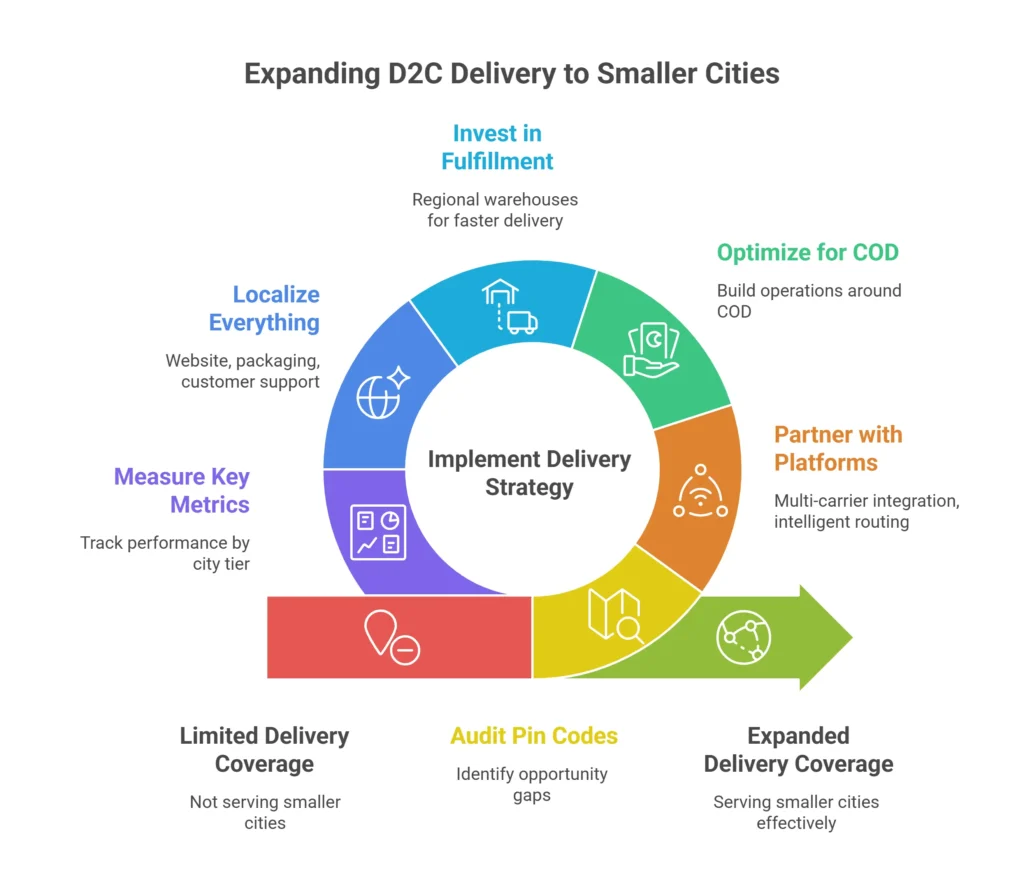
Step 4: Invest in Regional Fulfillment Identify 2 to 3 strategic locations for regional warehouses or fulfillment centers. Even small facilities of 2,000 to 5,000 square feet can significantly improve order fulfillment speed in small cities and reduce per-order shipping costs.
Step 5: Localize Everything From your website to your packaging to your customer support, localization matters. Invest in regional language ecommerce capabilities. Partner with local influencers. Create content that resonates with the cultural context of your target markets.
Step 6: Measure What Matters Track key metrics by city tier: delivery TAT (turnaround time), RTO rates, COD vs prepaid split, customer satisfaction scores, and repeat purchase rates. What gets measured gets managed.
Real Brands, Real Results
Several D2C brands in India have already proven that the Tier 2 and Tier 3 opportunity is real:
- Mamaearth has built a significant portion of its customer base from non-metro cities, leveraging strong social media presence and wide logistics coverage.
- boAt has seen explosive growth in smaller cities, driven by aspirational branding and aggressive pricing that resonates with value-conscious consumers.
- Lenskart invested heavily in both online delivery infrastructure and offline experience centers in Tier 2 cities, creating a hybrid model that builds trust.
- Platforms like Meesho have built their entire business model around the Tier 2 and Tier 3 opportunity, proving that small town delivery services in India can be both scalable and profitable.
These aren’t outliers. They’re early indicators of where the entire Indian D2C market is headed. And behind many of these success stories are logistics technology partners like DAAKit, quietly powering the infrastructure that makes Tier 2 and Tier 3 delivery possible at scale.
The Road Ahead
The Indian D2C market opportunity in Tier 2 and Tier 3 cities is not a future trend. It’s happening right now. Millions of new consumers in smaller cities make their first online purchase every single month. Logistics networks are expanding to cover more pin codes with each passing quarter. And year after year, digital adoption deepens while spending power continues to grow.
The brands that will win the next decade of Indian ecommerce aren’t necessarily the ones with the biggest budgets. They’re the ones willing to do the hard work of building delivery infrastructure, localizing their experience, and earning trust in markets that the rest of the industry has overlooked.
Tier 2 Tier 3 city delivery isn’t just a logistics challenge. It’s the single biggest growth lever available to Indian D2C brands today.
The question isn’t whether to expand into these markets. It’s whether you can afford not to.
If you’re a D2C brand ready to unlock this opportunity, start by exploring logistics partners like DAAKit that specialize in helping brands scale beyond metros. Audit your delivery coverage, diversify your fulfillment strategy, and invest in the localized experiences that smaller-city consumers deserve. The tools and playbooks exist. What’s needed is the commitment to execute.
Frequently Asked Questions
These cities are growing 2 to 3x faster than metros in ecommerce. Rising internet penetration, growing disposable incomes, and lower customer acquisition costs make them the biggest untapped opportunity for D2C brand expansion in India.
Key challenges include limited pin code serviceability, high RTO rates, heavy COD dependence, poor warehousing infrastructure, and higher shipping costs. Working with technology-driven logistics partners like DAAKit helps brands overcome these barriers at scale.
Brands should partner with smart logistics platforms offering multi-carrier integration, set up regional micro-warehouses or dark stores to shorten delivery distances, and incentivize prepaid payments to reduce RTO and improve order fulfillment speed.
Yes, COD still accounts for 60 to 70% of orders in these markets. Smart brands use automated order confirmation, fraud detection, and prepaid incentives like discounts and faster delivery to gradually shift the payment mix while keeping RTO rates under control.
Social commerce and WhatsApp are primary discovery and ordering channels in smaller cities. Regional language support boosts conversions significantly, while a strong post-purchase experience with real-time tracking and easy returns builds the trust needed to drive repeat purchases.