Let’s be honest. If you’re running a D2C brand in India, you’ve probably had that sinking feeling when you check your RTO dashboard on a Monday morning. Half your COD shipments came back. Your cash flow looks like a rollercoaster. And your logistics bill? Don’t even get started.
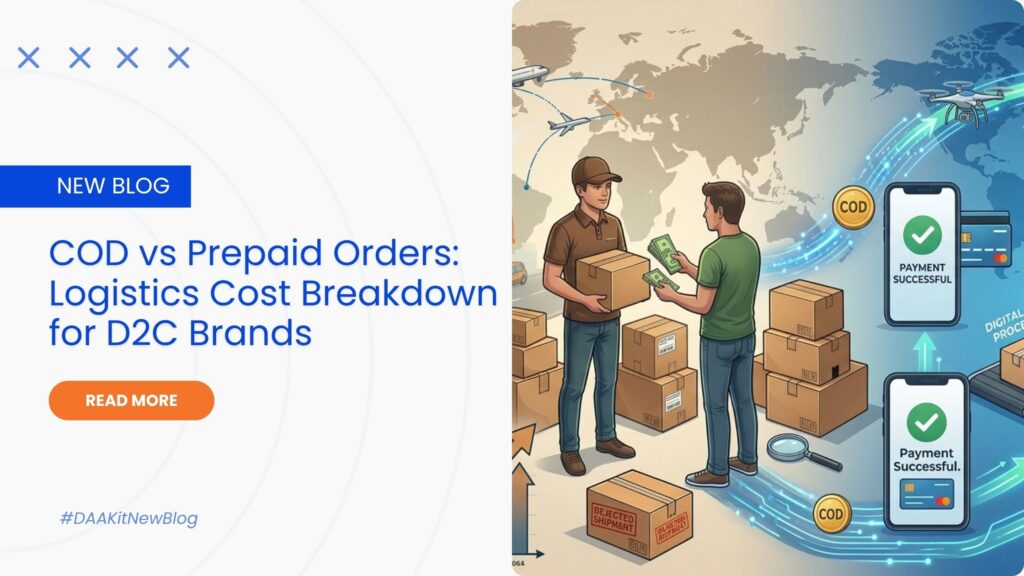
Here’s the thing: cash on delivery in ecommerce India isn’t going away anytime soon. On average, COD accounts for as high as 70% of all transactions, while net banking, credit/debit cards, and e-wallets make up just 30% . But that doesn’t mean you should accept the bleeding margins that come with it.
In this article, we’ll break down the real COD vs prepaid logistics cost for D2C brands, uncover the hidden expenses most founders overlook, and share actionable strategies to shift your order mix toward prepaid without killing your conversion rate. Ready? Let’s dig in.
What Is the Difference Between COD and Prepaid Orders in Ecommerce?
Before we crunch numbers, let’s get the basics right.
Cash on Delivery (COD) is a payment method where customers pay for their order only when it arrives at their doorstep. The delivery person collects the payment, deducts handling charges, and transfers the rest to the seller . In simple terms, delivery doesn’t equal payment. With COD, the actual delivery is just the first step because couriers can take days to remit the money.
Prepaid orders, on the other hand, are paid for upfront through UPI, credit/debit cards, net banking, or digital wallets. The money hits your account before the product even leaves the warehouse.
The difference sounds simple, but the downstream impact on your logistics costs, cash flow, and profitability is massive. Let’s see how.
The Real Logistics Cost Breakdown: COD vs Prepaid
This is where things get interesting. Most D2C founders look at the surface-level shipping cost and think, “COD is just ₹20-30 more per order.” But the actual COD logistics cost breakdown tells a very different story.
Forward Shipping Cost
COD orders usually entail higher courier charges due to the risk and handling associated with returns. Courier partners price COD shipments at a premium because they have to:
- Collect cash or manage POS payments at the doorstep
- Handle the reconciliation and remittance process
- Bear the risk of failed delivery attempts
For a typical D2C brand shipping lightweight products, the forward shipping cost difference between COD and prepaid can be ₹15-40 per order, depending on your courier partner and zone.
Return to Origin (RTO) Cost
This is the real killer. The RTO rate for COD orders shoots up to 25-30%, while for prepaid orders, it’s just 2-3%. Think about that for a second. For every 100 COD orders you ship, 25-30 are coming right back to your warehouse.
Every failed COD delivery increases your shipping and warehousing expenses because you’re paying for:
- Forward shipping (wasted)
- Reverse logistics to bring the product back
- Repackaging and quality check costs
- Restocking at the warehouse
The cost of a single RTO can range from ₹100 to ₹300+ depending on the product weight, zone, and courier partner. Multiply that by hundreds of orders a month, and you’ll see why your margins are disappearing.
If you want to dive deeper into tackling this problem, check out our detailed guide on how to reduce RTO in ecommerce.
Reverse Logistics Cost
Reverse logistics isn’t just about shipping the product back. It’s an entire chain of events that costs money at every step. The incidence of rejection is significantly higher for COD, meaning the reverse logistics on the undelivered package costs roughly the same as the original forward shipping.
For a comprehensive understanding of how reverse logistics works and the strategies to manage it, read our article on reverse logistics: how it works, types, and strategies.
COD Remittance Delay
Here’s a cost most founders don’t even think about. With prepaid orders, you’re already paid. But with COD, the remittance cycle can take anywhere from 7 to 14 days after successful delivery. That’s money stuck in the pipeline that you can’t use for inventory, marketing, or growth.
COD causes slower remittance cycles, which creates a cashflow challenge for small business owners. It impacts the growth of the business and causes operational issues. For a D2C brand doing ₹20-30 lakhs in monthly revenue with 60% COD, that’s potentially ₹8-12 lakhs locked up at any given time.
Multiple Delivery Attempt Charges
When a COD delivery fails on the first attempt (customer not home, wrong address, phone unreachable), the courier partner tries again. Each additional delivery attempt costs money. And here’s the frustrating part: couriers tend to prioritize prepaid orders first. COD deliveries often happen later in the day, and if there’s no time, they may mark them as attempted even if they weren’t.
This means your COD orders are already at a disadvantage in the delivery queue, leading to more failed attempts and higher NDR (Non-Delivery Report) rates.
The Hidden Costs of Cash on Delivery for Online Sellers
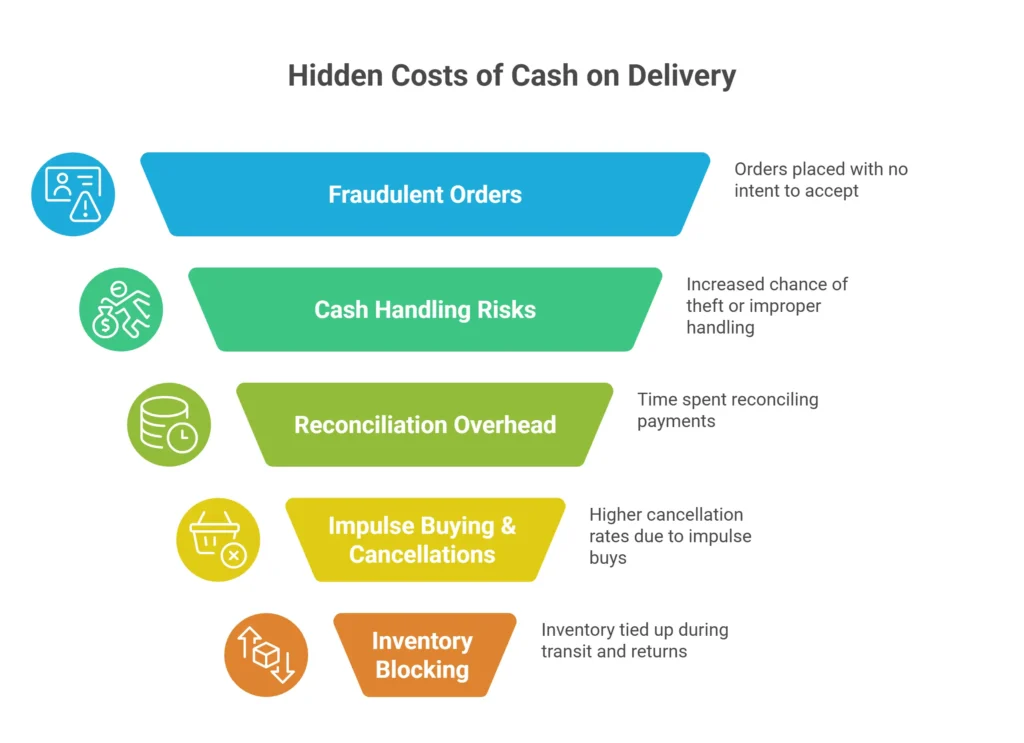
Beyond the obvious logistics expenses, COD brings several hidden costs that quietly eat into your bottom line:
- COD fraud and fake orders: Some customers place COD orders with no intention of accepting them. This is especially common during flash sales and heavy discount periods.
- Cash handling and security risks: During the distribution process, there’s an increased chance of theft or improper handling of cash.
- COD reconciliation overhead: Your operations team spends hours reconciling COD payments with courier remittance reports. That’s time and salary cost you’re not accounting for.
- Impulse buying and cancellations: COD involves a lot of impulse buying. Prepaid orders don’t come as easily unless you have a loyal customer base. This means COD orders have a significantly higher cancellation rate before they even ship.
- Inventory blocking: When a COD order is in transit for 5-7 days and then gets returned, that inventory was blocked for 10-15 days total. For fast-moving SKUs, that’s a real problem.
Why Prepaid Orders Are Better for D2C Brands
Transitioning to prepaid payments offers a clear path to reducing RTO rates and improving profitability. Here’s why:
Customer commitment: Prepaid payments require financial commitment upfront, reducing cancellations and ensuring customers are serious about their purchases. When someone has already paid ₹1,500 for a product, they’re going to make sure they’re home to receive it.
Streamlined logistics: Prepaid orders eliminate the need for cash handling, enabling faster delivery and fewer operational challenges. Your courier partners love prepaid orders because they’re simpler to deliver.
Faster cash flow: You get paid immediately. No remittance delays, no reconciliation headaches, no cash stuck in transit.
Lower RTO rates: With just 2-3% RTO compared to 25-30% for COD, prepaid orders dramatically reduce your reverse logistics costs.
Better customer lifetime value (CLV): Prepaid customers tend to be more intentional buyers with higher repeat purchase rates. They’re the customers you want to build your brand around.
Is Cash on Delivery Still Popular in India in 2026?
Yes, and that’s the reality every D2C brand has to work with. COD still accounts for a massive share of ecommerce transactions in India, especially in tier 2 and tier 3 cities where digital payment adoption is still growing.
However, there’s a silver lining. About 48% of COD users have switched or are ready to switch to prepaid orders. The rapid adoption of UPI, the growing trust in online payments, and better payment gateway integrations are all working in your favor.
The goal isn’t to eliminate COD entirely. It’s to strategically shift your prepaid order share while keeping COD available for customers who genuinely need it.
If you’re expanding into smaller cities, our guide on tier 2 and tier 3 city delivery for D2C brands in India covers the unique logistics challenges you’ll face.
7 Proven Strategies to Convert COD Orders to Prepaid
Now for the part you’ve been waiting for. Here are actionable strategies that D2C brands are using right now to improve their prepaid order share:
1. Introduce a COD Convenience Fee
A COD convenience fee can act as a deterrent for unnecessary COD orders . Charging a nominal amount like ₹50-₹100 for COD incentivizes customers to choose prepaid options. One Indian D2C footwear brand implemented a ₹60 COD charge and saw significant improvements within three months.
The key is to frame it as a “convenience fee” rather than a penalty. Most customers understand that COD involves extra handling.
2. Offer Prepaid Discounts and Incentives
Flip the script. Instead of charging more for COD, offer ₹50-100 off on prepaid orders. You can also offer:
- Free shipping on prepaid orders only
- Extra loyalty points for prepaid purchases
- Early access to new launches for prepaid customers
The math works because you’re saving ₹150-300 per order in potential RTO and reverse logistics costs.
3. WhatsApp COD-to-Prepaid Conversion
This is one of the most effective strategies in 2026. After a COD order is placed, send an automated WhatsApp message offering a small discount if the customer switches to prepaid before dispatch. Many brands report 15-25% conversion rates with this approach.
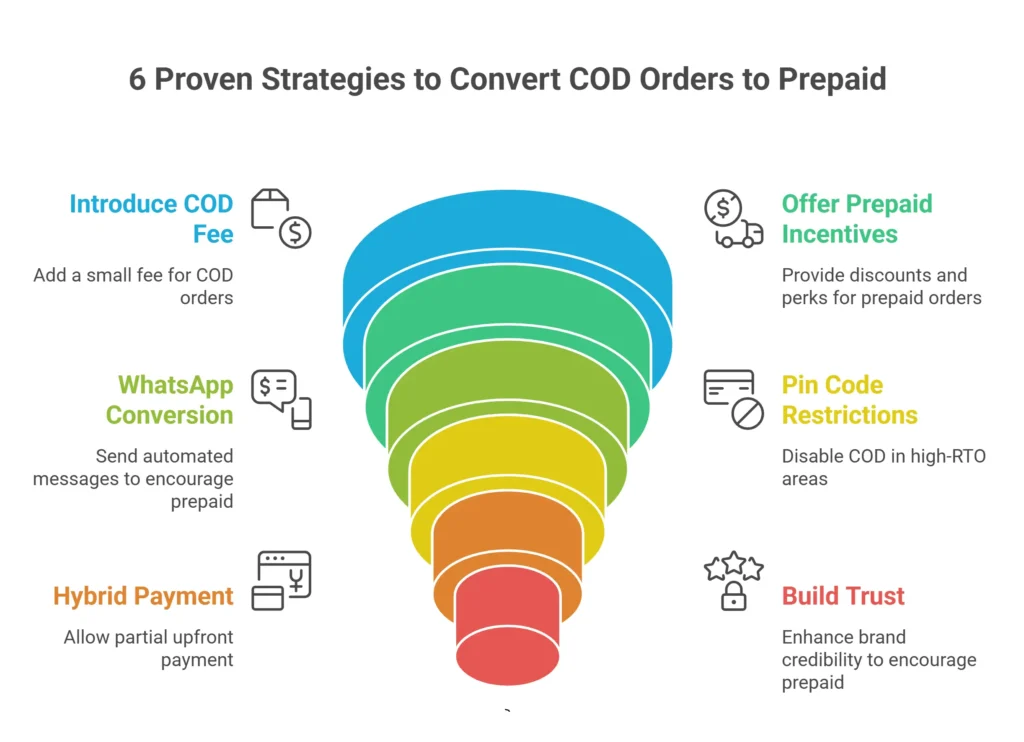
4. Pin Code Level COD Restrictions
Use your data. Analyze which pin codes have the highest RTO rates and disable COD for those areas. This is a surgical approach that reduces your worst-performing COD orders without affecting your overall conversion rate.
5. Implement Partial COD / Hybrid Payment
Allow customers to pay a portion upfront and the rest on delivery. For example, on a ₹2,000 order, the customer pays ₹500 online and ₹1,500 on delivery. This reduces your risk while still offering the comfort of COD.
6. Build Trust to Encourage Prepaid
Many customers choose COD because they don’t trust the brand yet. You can address this by:
- Showcasing customer reviews and ratings prominently
- Offering easy return and refund policies
- Displaying trust badges and secure payment icons
- Providing real-time order tracking
A great post-purchase experience builds the trust that converts first-time COD buyers into repeat prepaid customers.
7. Optimize Your Checkout Flow
Sometimes the problem is simply that your prepaid checkout is clunky. Make sure UPI, popular wallets, and card payments are front and center. Reduce the number of steps. Auto-apply prepaid discounts so customers see the savings immediately.
How Same-Day Delivery Impacts the COD vs Prepaid Equation
Here’s something most articles won’t tell you. Faster delivery reduces COD RTO rates significantly. When a customer receives their order within hours instead of days, the impulse-buy regret hasn’t kicked in yet. They’re still excited about the product.
This is where same-day and next-day delivery services become a strategic advantage, not just a customer experience upgrade. Brands using hyperlocal fulfillment and dark store or micro-fulfillment models are seeing lower RTO rates across both COD and prepaid orders.
The logic is simple: the shorter the delivery window, the less time there is for cancellations, address changes, and “I don’t want it anymore” moments.
Learn more about why same-day delivery matters in ecommerce and how it can transform your logistics economics.
COD vs Prepaid: A Quick Comparison Table
| Factor | COD Orders | Prepaid Orders |
|---|---|---|
| RTO Rate | 25-30% | 2-3% |
| Shipping Cost | Higher (COD premium) | Standard rates |
| Cash Flow | Delayed (7-14 days) | Immediate |
| Cancellation Rate | High | Low |
| Reverse Logistics Cost | Significant | Minimal |
| Customer Commitment | Low | High |
| Fraud Risk | Higher | Lower |
| Operational Complexity | High (reconciliation, cash handling) | Low |
The Bottom Line: Finding Your Ideal COD vs Prepaid Split
The perfect split doesn’t exist as a universal number. It depends on your product category, average order value, target audience, and geography. However, most successful D2C brands in India aim for a 60-70% prepaid and 30-40% COD split.
The journey from a 70% COD to a 70% prepaid order share doesn’t happen overnight. It requires a combination of smart pricing strategies, better checkout experiences, faster delivery, and consistent trust-building.
Every percentage point you shift from COD to prepaid directly improves your margins, cash flow, and operational efficiency. Some D2C brands have improved their prepaid share by 400-1000 basis points through systematic implementation of the strategies we’ve discussed.
If you’re looking for a logistics partner that helps you tackle last-mile delivery challenges and offers same-day fulfillment for D2C brands, Daakit can help you reduce RTO, speed up deliveries, and ultimately shift your order mix toward profitability.
Ready to cut your logistics costs and boost your prepaid share? Explore how Daakit’s fulfillment solutions can transform your D2C delivery operations today.
Frequently Asked Questions
COD orders in India have an RTO rate of 25-30%, while prepaid orders sit at just 2-3%. This gap means you’re paying for forward and reverse shipping on nearly a third of COD orders with zero revenue in return.
Courier partners can take 7-14 days to remit COD payments after delivery. For smaller D2C brands, this locks up working capital needed for inventory and marketing. Prepaid orders eliminate this gap entirely since money hits your account before the product ships.
Not entirely. COD still drives sales from first-time buyers and customers in tier 2 and tier 3 cities. Instead, strategically reduce it through convenience fees, prepaid discounts, pin code-level restrictions, and WhatsApp COD-to-prepaid conversion flows.
Same-day and hyperlocal delivery shrinks the window for customers to change their minds or become unavailable. The shorter the delivery time, the lower the RTO rate. Brands using quick commerce models report significantly fewer COD rejections compared to standard 3-5 day delivery.
Most profitable D2C brands aim for a 60-70% prepaid and 30-40% COD split. This varies by category, with fashion leaning more COD and electronics skewing prepaid. The key is to continuously improve your prepaid share through trust-building and smart incentives.