Quick commerce is no longer just a metro city phenomenon. In 2026, the rapid delivery economy has pushed far beyond Mumbai, Delhi, and Bangalore, reaching Tier 2 and Tier 3 cities where millions of digitally savvy consumers are hungry for niche products they couldn’t access before. From specialty skincare and pet care to sexual wellness and artisanal snacks, quick commerce D2C brands are rewriting the rules of how products reach consumers in smaller cities across India.
But here’s the real question: how exactly are these digitally native brands leveraging 10-minute delivery platforms to build loyal customer bases in places like Jaipur, Lucknow, Coimbatore, and Indore?
This article breaks it all down. Whether you’re a D2C founder exploring quick commerce expansion into smaller cities, or a logistics professional trying to understand the fulfillment infrastructure behind this boom, you’ll walk away with actionable insights, real examples, and a clear roadmap for 2026 and beyond.
If you’re new to the quick commerce landscape, we recommend starting with our detailed guide on quick commerce logistics for D2C brands for a solid foundation before diving in.
The Quick Commerce Boom: From Metro Luxury to Nationwide Necessity
Let’s rewind a bit. Quick commerce, or Q-commerce, started as an urban convenience play. Platforms like Blinkit, Zepto, and Swiggy Instamart built dense dark store networks in metro cities, promising 10-minute delivery on groceries and essentials. The value proposition was simple: why wait two days for something you need right now?
Fast forward to 2026, and the quick commerce market size in India has exploded. Industry estimates peg it at over $6 billion, with projections suggesting it could cross $10 billion by 2028. But the real story isn’t just about market size. It’s about where the growth is coming from.
Quick commerce D2C brands are increasingly finding their biggest growth pockets in non-metro cities. Platforms have realized that the metro market is getting saturated, with intense competition driving up customer acquisition costs. Meanwhile, Tier 2 and Tier 3 cities offer a massive, relatively untapped consumer base with rising disposable incomes, increasing smartphone penetration, and deep UPI adoption.
The numbers tell the story clearly. Over 55% of online orders during recent festive seasons came from beyond the top 8 metro cities. If you want to understand how e-commerce and traditional retail compete during India’s festive seasons, we’ve covered that in detail previously. Consumers in cities like Nagpur, Bhopal, Mysuru, and Chandigarh are not just ordering groceries. They’re ordering premium personal care products, organic food, fitness accessories, and even intimacy products through instant delivery apps.
This shift has opened a massive door for D2C brands in smaller cities to reach consumers who previously had zero access to their products. And the difference between quick commerce and traditional e-commerce for D2C brands in 2026 is becoming more pronounced every quarter.
Why Niche Categories Are Thriving on Quick Commerce
Here’s something most people don’t realize about quick commerce: it’s not just about speed. It’s about discovery.
Think about it. A consumer in Lucknow who’s interested in curly hair care products has limited options in local retail stores. Traditional e-commerce can deliver in 2-3 days, but the browsing experience is cluttered with thousands of options. Quick commerce platforms, on the other hand, offer a curated selection of products that are physically present in a nearby dark store, ready for instant delivery.
This curation effect is a goldmine for quick commerce D2C brands operating in niche categories. Instead of competing with 500 other brands on a marketplace search results page, a D2C brand on Blinkit or Zepto competes with maybe 5-10 alternatives in the same category. The visibility is dramatically higher, and the conversion rates reflect that.
The Niche Categories Leading the Charge
Several niche categories have seen explosive growth on quick commerce platforms in smaller cities:
- Pet Care: Premium pet food, grooming products, and accessories are seeing 3-4x growth in Tier 2 cities where pet ownership is rising rapidly but specialty pet stores are scarce.
- Sexual Wellness and Intimacy Products: The privacy of doorstep delivery has made quick commerce the preferred channel for sexual wellness brands. Consumers in smaller towns who might hesitate to buy these products in a physical store are ordering them with confidence through instant delivery apps.
- Specialty Skincare and Premium Personal Care: Korean skincare, clean beauty, and dermatologist-recommended products are finding eager audiences in cities like Kochi, Vadodara, and Dehradun.
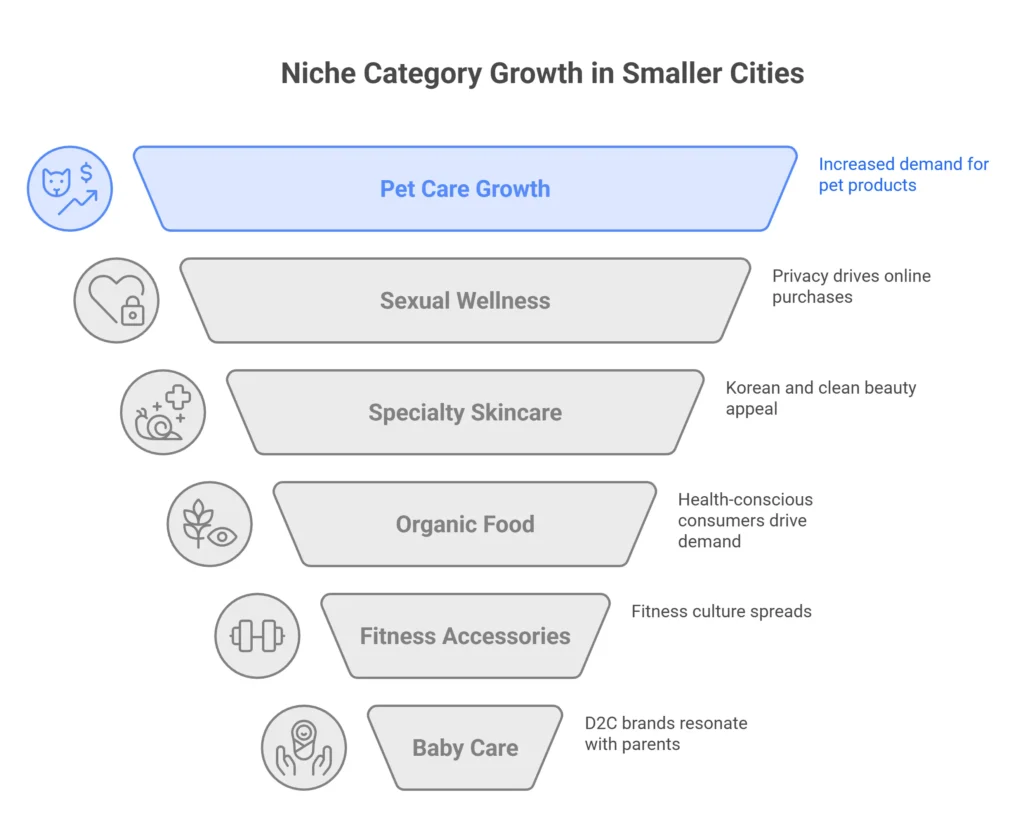
- Organic Food and Gourmet Snacks: Health-conscious consumers in smaller cities are driving demand for organic staples, artisanal snacks, and specialty beverages that were previously only available in metro gourmet stores.
- Fitness Accessories: Resistance bands, protein bars, yoga mats, and home workout equipment are seeing strong traction as fitness culture spreads beyond metros.
- Baby and Mother Care: Premium, chemical-free baby care products from D2C brands are resonating with young parents in Tier 2 cities who are highly research-driven and brand-conscious.
The common thread? These are all categories where local retail availability is limited, consumer awareness is growing through social media, and the convenience of quick delivery removes the last barrier to purchase. Understanding the importance of same-day delivery in e-commerce helps explain why speed is the ultimate conversion driver for these niche categories.
The Smaller City Opportunity: What’s Driving the Shift?
Understanding why quick commerce is expanding into Tier 2 and Tier 3 cities requires looking at several converging factors. We’ve previously explored the broader landscape of Tier 2 and Tier 3 city delivery for D2C brands in India, and the trends we identified are accelerating faster than expected.
1. Smartphone Penetration and Digital Adoption
India now has over 800 million smartphone users, and a significant chunk of new additions are coming from smaller cities and semi-urban areas. These consumers are digitally fluent, comfortable with app-based shopping, and increasingly expect the same convenience that metro consumers enjoy.
2. UPI Payments Revolution
UPI has fundamentally changed how India transacts. With over 14 billion monthly transactions, UPI penetration in Tier 2 and Tier 3 cities has removed the friction of online payments. Consumers who once relied on cash on delivery are now confidently making prepaid purchases, which is critical for quick commerce unit economics. Our analysis of COD vs prepaid orders and the logistics cost breakdown for D2C brands shows exactly how this shift impacts profitability.
3. Rising Aspirations and Social Media Influence
Instagram, YouTube, and influencer marketing have created awareness for niche products in every corner of India. A consumer in Ranchi sees the same skincare routine video as someone in Mumbai. The desire is identical. The only gap was access, and quick commerce D2C brands are closing that gap rapidly.
4. Limited Local Retail for Niche Products
This is perhaps the biggest driver. While metro cities have specialty stores, organic markets, and premium retail outlets, smaller cities often don’t. A consumer looking for a specific probiotic supplement or a sulfate-free shampoo in Raipur has very few offline options. Quick commerce brings these products to their doorstep in minutes.
5. Platform Expansion Strategies
Blinkit, Zepto, and Swiggy Instamart are aggressively expanding their dark store networks beyond metros. Blinkit alone has expanded to over 40 cities, with plans to reach 100+ cities by the end of 2026. This infrastructure buildout is the backbone that enables D2C brands to reach consumers in these new markets without building their own distribution networks. To understand the infrastructure behind this, read our guide on dark stores vs micro-fulfillment centers for D2C brands.
How D2C Brands Are Winning on Quick Commerce in Smaller Cities
So what does a winning D2C brand strategy for quick commerce actually look like? Here are the key tactics that successful quick commerce D2C brands are deploying:
1. SKU Optimization for Quick Commerce
Not every product in your catalog belongs on a quick commerce platform. Successful brands are carefully selecting SKUs based on:
- High repeat purchase potential (consumables, personal care, food)
- Impulse-friendly price points (typically under ₹500)
- Compact packaging (must fit efficiently in dark store shelves)
- Strong visual branding (stands out in a curated, limited-selection environment)
The goal is to optimize your product mix for the quick commerce context, not just dump your entire catalog onto the platform.
2. Platform Onboarding and Relationship Building
Getting listed on Blinkit, Zepto, or Swiggy Instamart isn’t just about filling out a form. Brands that succeed invest in building relationships with platform category managers, participating in platform-led promotions, and providing competitive margins that incentivize the platform to push their products.
Each platform has its own onboarding process, commission structures, and merchandising rules. Understanding these nuances is critical. For instance, Blinkit’s category expansion strategy favors brands that can guarantee consistent supply across multiple dark store locations.
3. Dark Store Fulfillment Strategy
The backbone of quick commerce is the dark store model. These are mini-warehouses, typically 2,000-4,000 sq ft, located in residential neighborhoods, stocked with high-demand products, and optimized for rapid picking and packing. If you’re unsure about the difference between a warehouse and a fulfillment center for your e-commerce business, understanding this distinction is essential before building your quick commerce strategy.
For D2C brands, the challenge is ensuring their products are consistently stocked across relevant dark stores in target cities. This requires:
- Reliable supply chain partnerships
- Demand forecasting at the pin code level
- Efficient inventory replenishment cycles
- Close coordination with platform logistics teams
Brands that nail dark store fulfillment see significantly higher visibility and conversion rates because their products are always available when consumers search for them. Our deep dive into hyperlocal fulfillment as a secret weapon for D2C brands in 2026 covers this in much greater detail.
4. Hyperlocal Marketing and Brand Discovery
One of the most underrated advantages of quick commerce for D2C brands is brand discovery. Many consumers discover new brands for the first time while browsing a quick commerce app. Unlike traditional e-commerce where search is intent-driven, quick commerce browsing is often exploratory.
Smart brands are amplifying this by running hyperlocal digital campaigns targeting consumers in specific cities where they’ve recently launched on quick commerce. The combination of digital awareness and instant availability creates a powerful conversion loop.
5. Leveraging Data for City-Level Insights
Quick commerce platforms provide granular data on consumer behavior at the city and even pin code level. Quick commerce D2C brands that actively analyze this data can identify which products resonate in which cities, optimize pricing for local purchasing power, and tailor their assortment strategy accordingly.
For example, a premium protein bar brand might discover that their chocolate variant sells 3x more in Chandigarh than in Pune, leading them to adjust dark store inventory allocation accordingly.
Challenges D2C Brands Face and How to Overcome Them
It’s not all smooth sailing. Quick commerce logistics challenges in smaller cities are real, and brands need to be prepared. Understanding the broader last-mile delivery challenges in e-commerce in India provides helpful context for what follows.
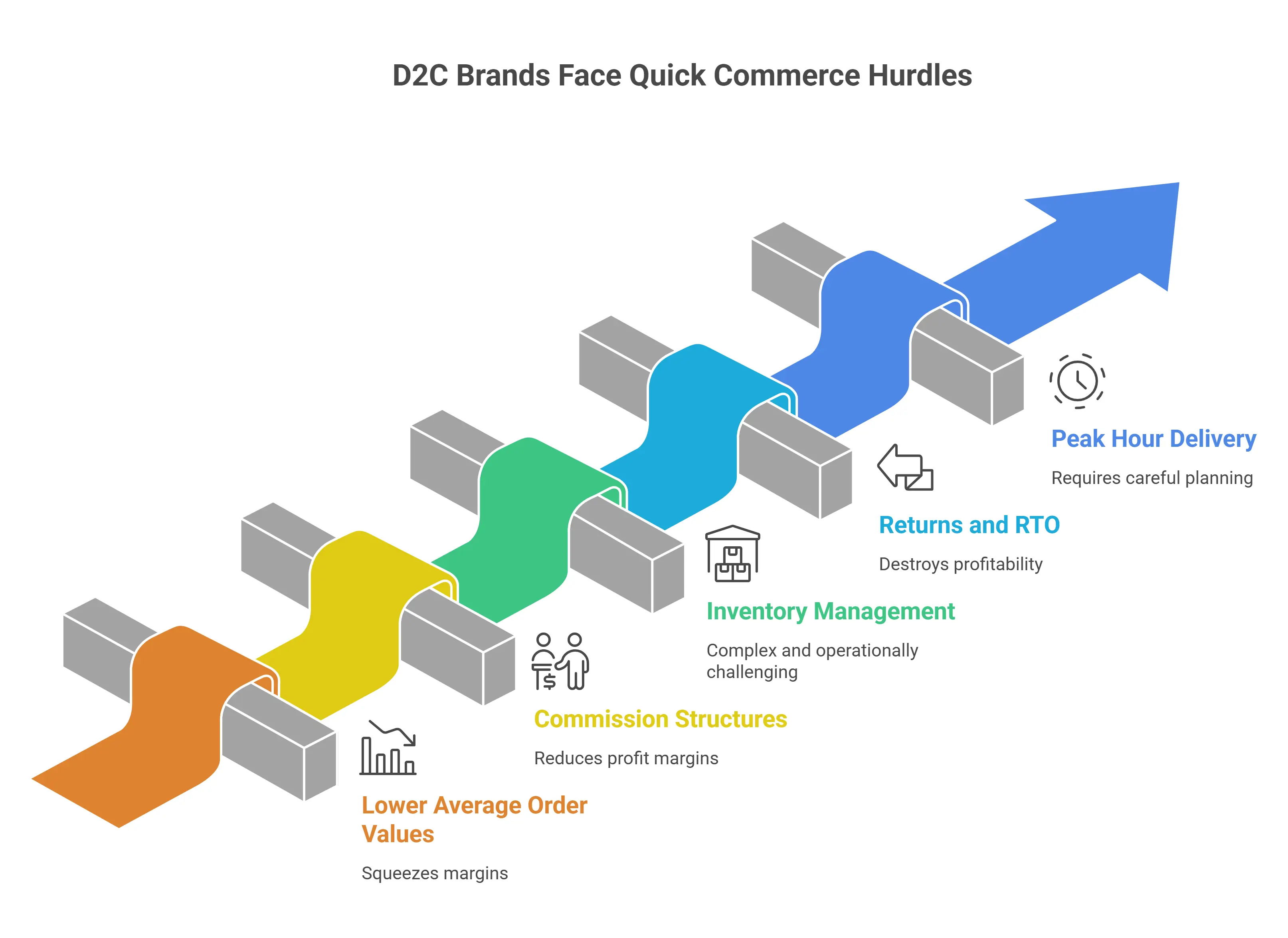
1. Lower Average Order Values (AOV)
Consumers in Tier 2 and Tier 3 cities tend to have lower AOVs compared to metro consumers. This can squeeze margins, especially when platform commissions are factored in. The solution? Focus on bundle offers, combo packs, and subscription-style repeat purchases that increase basket size.
2. Commission Structures and Margin Pressure
Platform commissions on quick commerce can range from 15-35% depending on the category and platform. For D2C brands with already thin margins, this can be challenging. The key is to view quick commerce as a customer acquisition and brand discovery channel rather than a pure profit center. The lifetime value of a customer acquired through quick commerce often justifies the initial margin hit.
3. Inventory Management Across Multiple Cities
Managing inventory across dozens of dark stores in multiple cities is operationally complex. Stockouts kill momentum, while overstocking ties up capital. Brands need robust inventory management systems and demand forecasting capabilities to maintain optimal stock levels.
This is where partners like DAAKit become invaluable. With plans to launch 25 new dark stores across Tier-I and Tier-II cities, backed by their recent $138K pre-seed funding from Inflection Point Ventures, DAAKit is building the hyperlocal fulfillment infrastructure that enables quick commerce D2C brands to scale their presence without the operational headaches. Explore DAAKit’s same-day fulfillment solutions for D2C brands to see how this works in practice.
4. Managing Returns and RTO
Returns are an inevitable part of e-commerce, and quick commerce is no exception. High RTO (Return to Origin) rates can destroy profitability, especially in newer markets where consumer behavior is still evolving. Having a solid reverse logistics strategy and implementing proven tactics to reduce RTO in e-commerce are non-negotiable for brands scaling into smaller cities.
5. Peak Hour Delivery Management
Quick commerce demand spikes during specific hours, typically mornings, lunch breaks, and evenings. Managing these peak hour deliveries as a D2C brand requires careful planning around rider availability, inventory positioning, and order batching to maintain delivery speed promises.
The Road Ahead: Quick Commerce and D2C in 2026 and Beyond
The convergence of quick commerce and D2C brands is still in its early innings, especially in smaller cities. As platforms continue expanding their dark store networks, as UPI adoption deepens further, and as consumer expectations for instant delivery become the norm rather than the exception, the opportunity for niche quick commerce D2C brands will only grow.
Several trends will shape this space in the coming months:
- Category expansion on platforms: Expect quick commerce platforms to aggressively onboard more niche categories, from home decor to stationery to hobby supplies.
- Private label competition: Platforms are launching their own private labels, which means D2C brands need to differentiate on quality, branding, and customer loyalty.
- Omnichannel integration: The smartest D2C brands will use quick commerce as one channel within a broader omnichannel strategy that includes their own website, marketplaces, and offline retail.
- Tech-driven fulfillment: AI-powered demand forecasting, automated inventory replenishment, and smart routing will become table stakes for brands operating across multiple quick commerce platforms and cities. Tools like the DAAKit Rider App are already helping brands optimize their delivery operations with real-time tracking and intelligent route planning.
The brands that win won’t just be the ones with the best products. They’ll be the ones with the smartest D2C brand distribution strategy in India, combining product-market fit with fulfillment excellence and data-driven decision making. And the post-purchase experience will be the ultimate differentiator that turns first-time quick commerce buyers into lifelong brand loyalists.
Ready to scale your D2C brand’s quick commerce presence across India’s fastest growing cities? DAAKit’s hyperlocal fulfillment infrastructure, backed by $138K in pre-seed funding from Inflection Point Ventures, is purpose-built to help brands like yours deliver faster, smarter, and more efficiently in Tier 2 and Tier 3 cities.
Frequently Asked Questions
By placing products in dark stores on platforms like Blinkit, Zepto, and Swiggy Instamart, D2C brands gain instant visibility in cities where their products aren’t available locally. This drives brand discovery and repeat purchases while lowering customer acquisition costs.
Pet care, sexual wellness, specialty skincare, organic food, fitness accessories, and baby care are leading the charge. These categories thrive because local retail availability is limited in smaller cities while social media keeps consumer awareness high.
Platform commissions range from 15-35%, but smart brands treat quick commerce as a customer acquisition channel. Optimizing SKUs for impulse pricing, bundling to boost AOV, and prepaid-first strategies help build sustainable profitability over time.
Dark stores are mini-warehouses (2,000-4,000 sq ft) optimized for rapid fulfillment in residential areas. Blinkit has expanded to 40+ cities, and partners like DAAKit are adding 25 new dark stores across Tier-I and Tier-II cities.
Select 10-15 hero SKUs with high repeat potential, pricing under ₹500, compact packaging, and strong branding. Test across cities, analyze platform data, and partner with hyperlocal fulfillment providers for seamless delivery and returns.